Topics
- Post
- Health & Wellness
- Biomarkers
- Behavior Impact
How WHOOP Advanced Labs connects bloodwork to daily coaching
Originally published on October 8, 2025
Bloodwork becomes more useful when you can see it next to the signals your body produces every day. Episode 344 of the WHOOP Podcast explains how WHOOP Advanced Labs pairs 65 biomarkers with more than 100,000 daily data points from the WHOOP app, then turns that information into coaching inside the app.
Will Ahmed and Ed Baker, Chief Product Officer at WHOOP, break the launch into five practical questions: what Advanced Labs is, how uploads work, how biomarkers feed coaching, what happens when you book testing through Quest Diagnostics, and how the feature supports a more preventive model of health. You will also see how clinician-reviewed reports, WHOOP Coach, the Weekly Plan, and the WHOOP Journal fit into the workflow.
To listen to episode 344 in full, head to the WHOOP Podcast on YouTube.
What is WHOOP Advanced Labs and why did WHOOP build it?
WHOOP Advanced Labs is a biomarker feature built around two use cases: uploading existing bloodwork and booking ongoing lab tests through the WHOOP app. The goal, Ahmed says, was to bring clinical lab data into the same place people already track sleep, recovery, training, stress, and behavior change.
The product direction came from demand inside the membership. Ahmed says nearly 70% of members told WHOOP they wanted this experience. That demand also maps to a real data gap. Continuous wearable metrics can show how your body is responding day to day, but they do not directly show biomarker status for things like cortisol, ferritin, ApoB, HOMA-IR, vitamin D, or HbA1c. Advanced Labs closes that gap by placing intermittent lab results next to ongoing physiology.
Baker frames biomarkers as an added layer alongside existing WHOOP metrics. In practical terms, that means a lower-than-expected HRV, persistent fatigue, or uneven recovery can now be examined alongside biomarkers that may help explain the pattern. The feature is built to answer a simple question: what might be underneath the signal you already see in the app?
Ahmed sets up the scale of that idea early in the episode.
"WHOOP Advanced Labs has tests across 65 biomarkers. We pair that with over 100,000 daily data points as collected by WHOOP."
What you should take away
- WHOOP Advanced Labs is built around two paths: past bloodwork uploads and ongoing lab testing through the WHOOP app.
- Ahmed says nearly 70% of members said they wanted bloodwork inside WHOOP.
- The feature adds biomarker context to existing WHOOP metrics such as Sleep, Recovery, Strain, and stress.
- WHOOP positions biomarkers as an added health layer alongside continuous wearable data.
If you want to hear Baker unpack why biomarkers became a missing layer in the WHOOP experience, listen to the full episode on Youtube.
How does WHOOP turn past bloodwork into usable health trends?
That broader idea gets practical through uploads. WHOOP members can add prior bloodwork from any provider, including tests ordered through a doctor, then view those results over time inside the app. Baker says the upload feature is built to create a trend view of biomarkers across time.
That helps anyone whose testing history lives across portals, PDFs, inboxes, and clinic systems. Ahmed describes having results from different providers over several years and spending about 45 minutes trying to reconstruct even one biomarker trend. WHOOP Advanced Labs is designed to remove that friction by storing the measurement date for each data point and organizing biomarkers in one place.
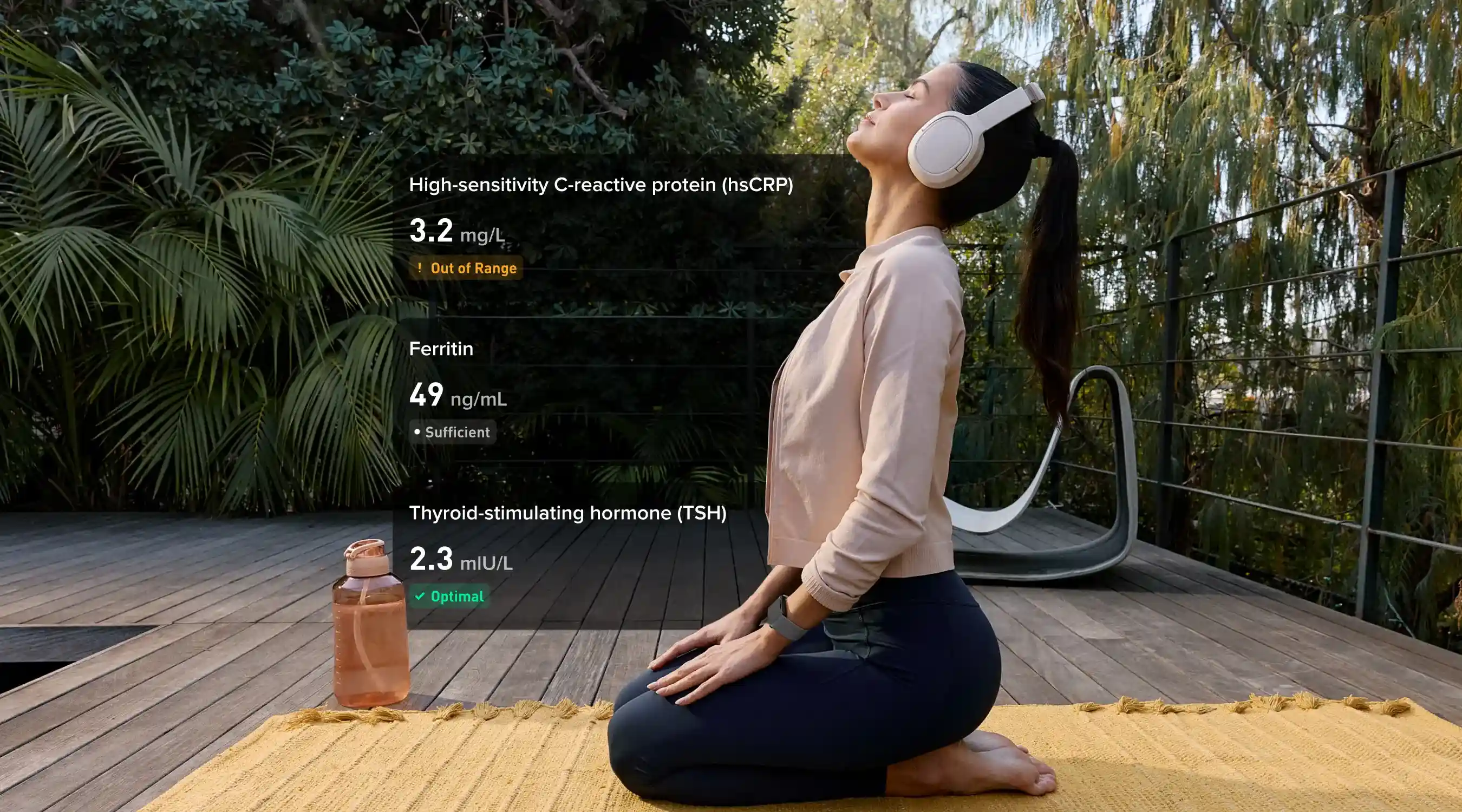
The interface also changes how you review a panel. The app surfaces biomarkers by status and lets you drill down from there. Ahmed and Baker describe three categories used in the design: optimal, sufficient, and out of range. That layout helps people focus attention on the markers most likely to need action first.
Baker also notes that uploading multiple historical tests helps reveal direction as well as current status. A single lab draw can be useful, but a sequence of results shows whether a marker is improving, drifting, or holding steady. That trend view is one reason the feature is available even if you never purchase a new test through WHOOP.
Baker describes the scope of uploads in very direct terms.
"Any existing WHOOP member can upload any bloodwork testing they've done in the past as much as they'd like."
What you should take away
- WHOOP members can upload past bloodwork from any provider as PDFs or photos inside the app.
- Multiple uploads matter because biomarker trends over time are more informative than a single result.
- WHOOP stores the date tied to each lab value, which helps keep longitudinal trends accurate.
- The app organizes biomarkers by status so you can review out-of-range markers first.
If you want to hear Baker go deeper on how past lab uploads become trend data, listen to the full episode on Youtube.
How does WHOOP connect biomarker results to sleep, recovery, and coaching?
Once lab data is inside the app, WHOOP uses it to deepen coaching instead of leaving it as a static report. Ahmed says WHOOP updated WHOOP Coach alongside the launch, using newer models from OpenAI and pulling in WHOOP research on biomarkers so members can ask follow-up questions in plain language.
That moves the experience beyond reading numbers and into asking for context. Ahmed gives a simple example: asking why iron looks lower than expected. In his description, WHOOP Coach returned a multi-paragraph response with possible explanations and tied the answer back to patterns in sleep, location, and other app data. The practical value is interpretation inside the same environment where people already track behavior.
Baker gives the clearest example of how that coaching loop works. He says his own cortisol ran high, and that may help explain lower HRV despite being an endurance athlete. WHOOP Coach then linked that biomarker back to sleep consistency and sleep duration, two behaviors already measured continuously by WHOOP. The system can connect a lab result to a wearable signal and then connect both to a daily action.
The same logic applies across other markers mentioned in the episode. Baker uses glucose and HbA1c to illustrate how short sleep and irregular schedules become part of a longer-term health conversation as well as a next-day readiness issue. He also points to vitamin D and cholesterol as examples where the Weekly Plan and WHOOP Journal can help track whether new habits are being followed between tests.
Baker summarizes that feedback loop with a concrete mechanism.
"Cortisol can cause my HRV to be lower. And then it also told me that sleep consistency and sleep duration can help improve cortisol levels."
For people who want more background on which markers show up in the feature, WHOOP has also published a guide to 10 biomarkers that matter most for your health and a product overview of WHOOP Advanced Labs.
What you should take away
- WHOOP Coach uses biomarker results to explain possible causes behind trends in Sleep, Recovery, stress, and HRV.
- Baker uses high cortisol and lower HRV as an example of how a lab result can add context to wearable data.
- The Weekly Plan and WHOOP Journal give members a way to track actions between tests.
- Biomarker coaching is most useful when it links a result, a daily pattern, and a specific next step.
If you want to hear Baker unpack how cortisol, HRV, and sleep consistency connect, listen to the full episode on Youtube.
What happens when you book testing through WHOOP Advanced Labs?
For people who want ongoing testing, WHOOP also lets members book lab work through the app in partnership with Quest Diagnostics. Baker says Quest Diagnostics was selected in part because it has about 2,000 patient service centers across the United States, which makes access practical for a large number of people.
The workflow described in Episode 344 of the WHOOP Podcast is simple. A member books an appointment in the app, chooses a nearby location, gets the blood draw, and then receives results back inside the app. Ahmed says the visit itself took about 15 minutes in his case. He also notes that results can begin arriving before the full panel is complete. In his experience, some markers appeared within about 24 hours and the rest arrived over the course of the week.
WHOOP then layers on two more pieces: a clinician-reviewed report from a licensed clinician and an action plan tied to the results. Baker says the report identifies which biomarkers are off, what they may mean, and which actions are worth focusing on first. Ahmed says this is also the first time he has had a clinician use WHOOP data alongside bloodwork to interpret what he is seeing, instead of trying to compare two disconnected systems.
The app design keeps the panel manageable after testing. Ahmed describes a dial that shows how many biomarkers are optimal, sufficient, or out of range. That is a small detail, but it reflects the larger product choice behind Advanced Labs: guide attention to the few markers that need action first.
Baker explains the access side in one sentence.
"Quest has 2,000 patient centers all around the United States."
WHOOP has also expanded this topic in Episode 345 of the WHOOP Podcast and Episode 348 of the WHOOP Podcast, which both dig further into biomarker interpretation and action planning.
What you should take away
- WHOOP lets members book bloodwork through the app with Quest Diagnostics in the United States.
- Baker says Quest Diagnostics has about 2,000 patient service centers, which expands practical access.
- Ahmed says his blood draw took about 15 minutes and some results appeared within about 24 hours.
- A licensed clinician reviews the panel and provides an action plan inside the WHOOP app.
If you want to hear Baker go deeper on how booking, blood draw timing, and results delivery work, listen to the full episode on Youtube.
How do biomarkers support preventive health and Healthspan on WHOOP?
The final point in the episode extends past the test itself. Ahmed and Baker describe Advanced Labs as a step toward a health operating system where bloodwork, wearable data, coaching, and habit tracking live under one roof. The practical case for that model is prevention.
Baker argues that earlier information is easier to act on. A biomarker result can flag an issue before it becomes obvious in everyday life, and before it becomes harder to address. Ahmed makes the same case through examples from the beta group and the office, where people changed behavior quickly after seeing cholesterol, iron, or vitamin D results. Baker gives one personal example from dinner, saying he chose fish instead of steak after seeing his own cholesterol trend.
The episode also ties biomarkers to Healthspan, the part of the WHOOP experience that looks at contributors to long-term health. Baker specifically names HOMA-IR as a gold-standard measure of insulin resistance, ApoB as a marker tied to LDL particle concentration and cardiovascular risk, and cortisol as a hormone that affects recovery, sleep, focus, and energy regulation. Those examples show how Advanced Labs is meant to inform both day-to-day coaching and longer-term health direction.
The privacy point is part of that long-term trust argument. Ahmed says data is encrypted and not shared without consent, while Baker calls privacy and trust non-negotiable. He adds that WHOOP has a dedicated team focused on keeping health data private and secure, and Ahmed says two-factor authentication is also being rolled out.
Baker gives the clearest summary of the preventive aim here."It's so much easier to address problems when you catch them early before they become serious problems."
What you should take away
- WHOOP positions Advanced Labs as a preventive health feature built for earlier detection and earlier action.
- Baker connects specific biomarkers to long-term health context, including HOMA-IR, ApoB, and cortisol.
- Health choices can change quickly when lab results are tied to the Weekly Plan, WHOOP Journal, and WHOOP Coach.
- Ahmed and Baker say privacy protections and consent controls are essential when bloodwork lives inside the WHOOP app.
The bottom line
- WHOOP Advanced Labs combines 65 biomarkers with more than 100,000 daily data points to place lab results in the context of daily physiology.
- WHOOP members can upload historical bloodwork from any provider, which makes biomarker trends easier to review over time.
- WHOOP Coach turns biomarker results into follow-up explanations that can connect lab markers to Sleep, Recovery, HRV, and behavior change.
- Baker uses high cortisol and lower HRV as a clear example of how a lab result can explain a wearable pattern.
- WHOOP members in the United States can book testing through Quest Diagnostics, which Baker says includes about 2,000 patient service centers.
- A licensed clinician reviews lab results booked through WHOOP and provides an action plan inside the app.
- Advanced Labs is designed to support earlier health decisions by surfacing out-of-range biomarkers before they become bigger problems.
- Privacy, encryption, consent controls, and two-factor authentication are part of the trust model Ahmed and Baker describe around lab data.
Frequently asked questions about things discussed in this episode
How does WHOOP Advanced Labs use past bloodwork?
WHOOP lets members upload past bloodwork as PDFs or photos, then organizes biomarkers by date so trends can be reviewed over time inside the WHOOP app.
What does WHOOP Advanced Labs measure?
WHOOP Advanced Labs includes testing across 65 biomarkers, and the app highlights whether markers are optimal, sufficient, or out of range.
How does WHOOP connect biomarkers to Sleep and Recovery?
WHOOP connects biomarker results to Sleep, Recovery, HRV, and other app data through WHOOP Coach, which can explain how a result may relate to daily physiology and habits.
What happens after a WHOOP Advanced Labs blood draw?
WHOOP returns results inside the app, then adds a clinician-reviewed report and an action plan that members can tie into the Weekly Plan and WHOOP Journal.
What does WHOOP do for privacy with lab data?
WHOOP says lab data is encrypted, not shared without consent, and protected by dedicated privacy and security work that includes two-factor authentication.
What does WHOOP use biomarkers for in Healthspan?
WHOOP uses biomarkers to add context to longer-term health contributors, including markers Baker names in the episode such as HOMA-IR, ApoB, and cortisol.
By placing bloodwork next to nightly Sleep, daily Recovery, and longer-term Healthspan context, WHOOP Advanced Labs turns lab results into something you can use between tests.
Related Articles
WHOOP Advanced Labs: Lab results meet daily coaching
Topics
- Health & Wellness
- App & Features
- Biomarkers
Health Biomarkers: 10 Key Metrics with WHOOP Advanced Labs
Topics
- Biomarkers
- Metabolic Health
- Heart Health
How meditation, service, and self-knowledge can change your life

Topics
- Health & Wellness
- Mental Health