Topics
- Article
- Sleep
- App & Features
How Much Sleep Do You Need? Use WHOOP Sleep Planner

Getting enough sleep is essential to human performance and overall health, allowing your body to repair and restore itself in preparation for the day ahead. While 8 hours per night is commonly accepted, everybody is different with unique sleep needs influenced by factors like previous nights' sleep, stress, and activity level. This guide explores the science behind sleep recommendations and how the WHOOP Sleep Planner provides a personalized answer to help you perform at your best.
How much sleep is generally recommended?
Most health organizations agree that adults need between 7 to 9 hours of sleep per night to support optimal health. This general guideline serves as a solid starting point. However, this range doesn't account for you as an individual.
Your personal sleep needs can be higher or lower depending on factors like age, genetics, and daily activity levels. While it's a useful benchmark, a single static number doesn't tell the whole story about your unique requirements for peak performance.
Why sleep quality matters as much as quantity
The number of hours you spend in bed is only one part of the equation. True restoration happens when you achieve high-quality sleep, determined by your sleep architecture — how much time you spend in the different stages of sleep. Your body needs sufficient time in both Deep Sleep for physical repair and REM Sleep for cognitive processing and memory consolidation.
Eight hours of restless, interrupted sleep will not leave you feeling as recovered as seven hours of efficient, consolidated sleep. This is why understanding your sleep quality is essential for unlocking your full potential.
What is a normal amount of sleep?
WHOOP automatically tracks your sleep in detail down to the minute, including time spent in each stage of sleep (light sleep, deep/slow wave, REM and awake). Below is a graph showing the range of typical bed and wake times for all WHOOP members:
The distribution of bed and wake times for all WHOOP members, with an average bedtime of 11:28 pm and wake time of 7:18 am.
On average, WHOOP members spend just under 8 hours in bed per night. But time in bed is not the same as time asleep. Regular disturbances throughout the night—which we're often not even conscious of—can add up to significant sleep loss.
Average sleep time for men and women
The average length of time WHOOP members actually sleep per night is slightly more than 7 hours. For men the average sleep time is 7:03, and for women it's 7:20. Female WHOOP members also spend about 15 minutes more per night in bed than males do.
However, there's a significant difference between how much sleep people get and how much they need to perform optimally. In fact, the average sleep need for WHOOP members is 8:34 per night. Where does this number come from?
The WHOOP Sleep Planner: a personalized answer
The WHOOP Sleep Planner incorporates your unique physiology, recent sleep, and the physical and mental demands put on your body to calculate precisely how much sleep you need each night. Here's how it works:
- Baseline: Your baseline sleep need is the amount of sleep you should get every night prior to other factors coming into play. It is determined by your physiology, which WHOOP begins to learn about as soon as you put on the Strap.
- Strain: WHOOP quantifies the strain or physiological exertion your body takes on from things like exercise, stress, and normal daily activities. The more Strain you accumulate during the day, the more sleep you need at night.
- Sleep Debt: When you don't get all the sleep you need at night, you start to build up sleep debt. In the WHOOP app, sleep debt refers to the amount of extra sleep your body requires tonight due to insufficient sleep on previous nights.
- Naps: If you take a nap during the day, your sleep need that night is reduced by the amount of time you napped for.
- Typical Sleep Patterns: WHOOP evaluates the bed/wake times, duration, and efficiency over the past 28 days.
- Lifestyle and Behavior: WHOOP smooths out weekend vs weekday shifts, travel, or time zone changes.
All of these are combined to calculate your personal sleep need each night.
What's a healthy amount of sleep when you can't get all you need?
Life can often get in the way of achieving your ideal amount of sleep on a regular basis. So what should you aim for when that's not possible? Is 7 hours of sleep enough? What about 6?
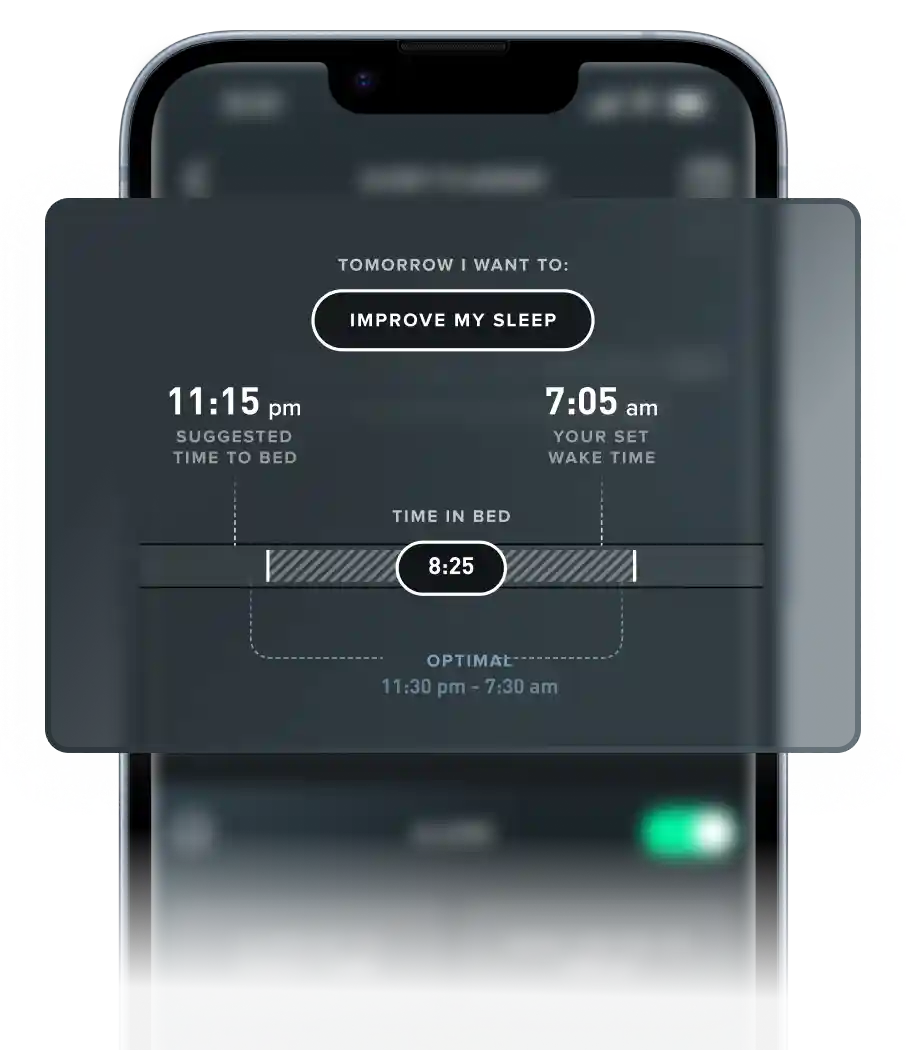
It depends on circumstances and varies for everyone. The WHOOP Sleep Planner allows for this by giving you the option to set your Sleep Goal to your Weekly Plan, Improve My Sleep, or Reach My Sleep NeedYou can also adjust these settings based on the day of the week and build a schedule.
Your best time to sleep and wake up
Beyond simply suggesting how much time to spend in bed at night, the Sleep Planner uses recent scientific research on the value of sleep consistency and incorporates your natural circadian rhythm to offer the most effective times for you to go to bed and wake up. You can also specify your intended wake-up time and the Sleep Planner will adjust your advised bedtime accordingly. Each evening, the WHOOP app sends you a notification with your recommended sleep need and optimal time to go to sleep.
And with the WHOOP featuring haptic alarms, you can set the Sleep Planner to wake you silently and gently at a specific time, when you've hit your sleep goal, or when your recovery is in the green.
Frequently asked questions about sleep needs
What is the 10-3-2-1 rule for sleep?
The 10-3-2-1 rule is a simple guideline to help you prepare for better sleep. It suggests stopping caffeine 10 hours before bed, finishing large meals and alcohol 3 hours before, ending work-related activities 2 hours before, and turning off screens 1 hour before you plan to sleep. This routine helps your body wind down naturally.
Is it better to get 7 or 8 hours of sleep?
For most adults, 8 hours is a better target than 7, but the truly optimal amount is personal. Your ideal sleep duration depends on your individual baseline, recent sleep debt, and daily Strain. On a low-activity day when you're fully rested, 7 hours might be sufficient.
After a strenuous workout or a period of high stress, your body will likely need 8 hours or more to fully recover.
Is sleeping 6 hours in one night okay?
While you can 'get by' on 6 hours of sleep occasionally, making it a habit will lead to accumulating sleep debt. When you get less sleep than your body needs, your cognitive function, mood, and physical recovery will be impaired the next day. WHOOP quantifies this impact, showing you exactly how a night of insufficient sleep affects your Recovery score and your readiness to perform.