Topics
- Post
- Biomarkers
- Health & Wellness
How WHOOP Advanced Labs connects biomarker data to healthspan
Originally published on October 14, 2025
WHOOP Advanced Labs is built to help you understand how biomarker data connects to daily behaviors, and this article explains six questions at the center of that work: what longevity actually means, which markers can flag risk early, why insulin deserves special attention, how to keep data useful, which daily metrics matter most, and how root-cause thinking can lead to better next steps. In Episode 345 of the WHOOP Podcast, Emily Capodilupo, Senior Vice President of Research, Algorithms, and Data at WHOOP, speaks with Dr. Robin Berzin, Founder and CEO of Parsley Health, and Dr. Dan Henderson, member of the WHOOP Medical Advisory Board and Primary Care Physician at Brigham and Women’s Hospital and Harvard Medical School, about connecting labs, wearables, and behavior change so people can act earlier.
To listen to Episode 345 of the WHOOP Podcast in full, head to the WHOOP Podcast on Spotify.
What does longevity mean if the real goal is healthspan
Longevity, as Berzin and Henderson describe it here, is really a question of function. The goal is to preserve energy, mobility, cognition, and independence across future decades so your healthiest years can still be ahead of you.
Berzin frames that idea in practical terms. She is less interested in a distant age target than in what the next decade looks like as a parent, at work, and in everyday life. Henderson makes the same point from a physician’s angle: if you care about future function, you need measurements that show change before disease is obvious.
Henderson put that definition plainly when the conversation turned to healthspan.
“Nobody is trying to figure out how to keep somebody alive at any cost to 160 or 200. It’s really all about how do you preserve the function and capabilities that we enjoy in younger life.”
That frame is important for understanding why WHOOP Advanced Labs sits next to daily WHOOP data. Lab values can show long-term physiological drift, while Sleep, Recovery, Strain, and behavior logging show the day-to-day habits that may be pushing those markers in one direction or another. Henderson’s point is that goals need measures. Berzin’s point is that those measures should connect back to daily life, not sit in a vacuum.
The conversation also widens the usual definition of preventive care. A standard annual physical may help catch obvious risk. Berzin and Henderson are talking about earlier pattern recognition, the kind of change that shows up before a heart attack, diabetes diagnosis, or major loss of function. That is the promise behind linking bloodwork with continuous behavior data.
If you want to hear Berzin unpack how she defines healthspan and future function, listen to the full episode on Spotify.
What you should take away
- Healthspan in this episode means protecting function, energy, and independence across future decades.
- Berzin and Henderson both argue that better future health starts with earlier measurement, not later crisis care.
- WHOOP Advanced Labs fits this frame by connecting periodic lab results to continuous daily signals such as Sleep, Recovery, and Strain.
Which biomarkers can show risk before disease becomes obvious
Once healthspan becomes the goal, the next question is which biomarkers help you see risk early enough to act. Berzin and Henderson highlighted metabolic markers, cardiovascular risk markers, inflammation, thyroid function, nutrient status, and female hormone patterns as especially useful places to look.
Berzin called out fasting insulin as one of the clearest examples of an early warning marker. She also pointed to thyroid markers, especially in women whose symptoms can be misread or brushed aside, and to nutrient markers such as vitamin D and magnesium when people feel run down but do not yet meet a disease threshold. Henderson agreed on insulin and added ApoB, or apolipoprotein B, as a heart-health marker that can reveal more than a standard cholesterol panel in some people.
He also spent time on lipoprotein(a), usually written Lp(a), because it can surface inherited cardiovascular risk in people who otherwise look healthy. Henderson described checking it on a friend during a testing pilot and seeing the highest value he had encountered in his career. In that case, a result from a lab panel prompted cardiac follow-up that may have changed the person’s trajectory years before a major event.
Henderson’s explanation of Lp(a) is one of the most specific moments in the episode.
“It’s an abnormal lipoprotein that’s 5 or 6 times more good at generating blockages and heart attacks, and also has some functionality to produce the clots that clog them up instantaneously.”
Berzin adds another layer here. Some markers help you get ahead of disease. Others help explain why you feel flat right now. A person can have suboptimal vitamin D, magnesium, thyroid function, or hormone patterns without having a diagnosis that forces action. In her view, that is exactly why earlier testing matters.
For people who want more on how WHOOP brought this lab panel together, read Dr. Dan Henderson on How We Developed WHOOP Advanced Labs. For Henderson’s full take on early cardiovascular risk markers, listen to the full episode on Spotify.
What you should take away
- Fasting insulin, ApoB, Lp(a), thyroid markers, and inflammation markers can reveal drift before a diagnosis becomes obvious.
- Lp(a) is especially useful because inherited cardiovascular risk can appear in people who do many things right.
- Berzin’s framework separates disease-prevention markers from quality-of-life markers, and both categories matter.
- Earlier testing gives people a better chance to act while change is still easier to make.
Why does insulin deserve as much attention as glucose
Insulin matters because it often shows metabolic strain earlier than glucose alone. Glucose tells you how much sugar is in the bloodstream at a given moment. Insulin tells you how hard the body has to work to control that sugar.
Berzin explains this in simple physiological terms. When people eat more refined carbohydrate than their bodies can handle well, move too little, or carry too little muscle, blood sugar rises and insulin moves in to push that sugar back into cells. Over time, the system can become less responsive. A person may still look fine on familiar diabetes screening, while fasting insulin is already showing that the body is under pressure.
That early metabolic pressure matters far beyond diabetes. Berzin notes that elevated insulin can shape sex hormone patterns, which is one reason insulin shows up so often in conversations about polycystic ovary syndrome, premenstrual symptoms, fertility, and weight change. Henderson makes a similar point from the internist’s side, describing insulin resistance as a driver of feeling “meh,” trouble losing weight, and failing to get the response you want from training.
Berzin used one of the episode’s strongest metaphors to explain why this matters.
“When you have too much sugar floating around in your bloodstream, it coats your red blood cells like a Frosted Flake, and your red blood cells then can’t deliver oxygen.”
She goes on to explain that hemoglobin A1C measures how much those cells have been exposed to sugar over time. In other words, A1C can be a later snapshot of a process that fasting insulin may reveal earlier. Berzin also stressed that this process can move in the right direction within weeks or months when sleep, activity, food choice, and muscle-building improve.
That is where WHOOP Advanced Labs becomes more useful than an isolated lab report. A fasting insulin result becomes easier to interpret when it sits beside sleep regularity, activity level, time in different heart rate zones, and the behavior notes you add in the WHOOP app.
If you want to hear Berzin go deeper on insulin, glucose, and women’s hormone patterns, listen to the full episode on Spotify.
What you should take away
- Glucose shows the amount of sugar in the blood, while insulin shows the effort required to keep that sugar controlled.
- Fasting insulin can surface metabolic strain before hemoglobin A1C rises into a diabetes range.
- Berzin links insulin to sex hormone patterns as well as energy, weight change, and long-term metabolic health.
- WHOOP data can add context by showing the daily habits that may be tied to insulin trends over time.
How can WHOOP Advanced Labs make lab results easier to use
Early detection only helps when results are understandable in context. Henderson’s view is that biomarker data becomes easier to use when it appears next to daily behavior, symptoms, and wearable data instead of arriving as a disconnected PDF.
He described years of caring for scientists and quantitative patients who would show up with spreadsheets and colorful graphs that never fit neatly into the electronic health record. Even inside large health systems, it can be hard to tell what a person was doing when a given value was measured. That is a problem if you want to know whether a marker changed because of sleep, training, inflammation, medication, diet, or illness.
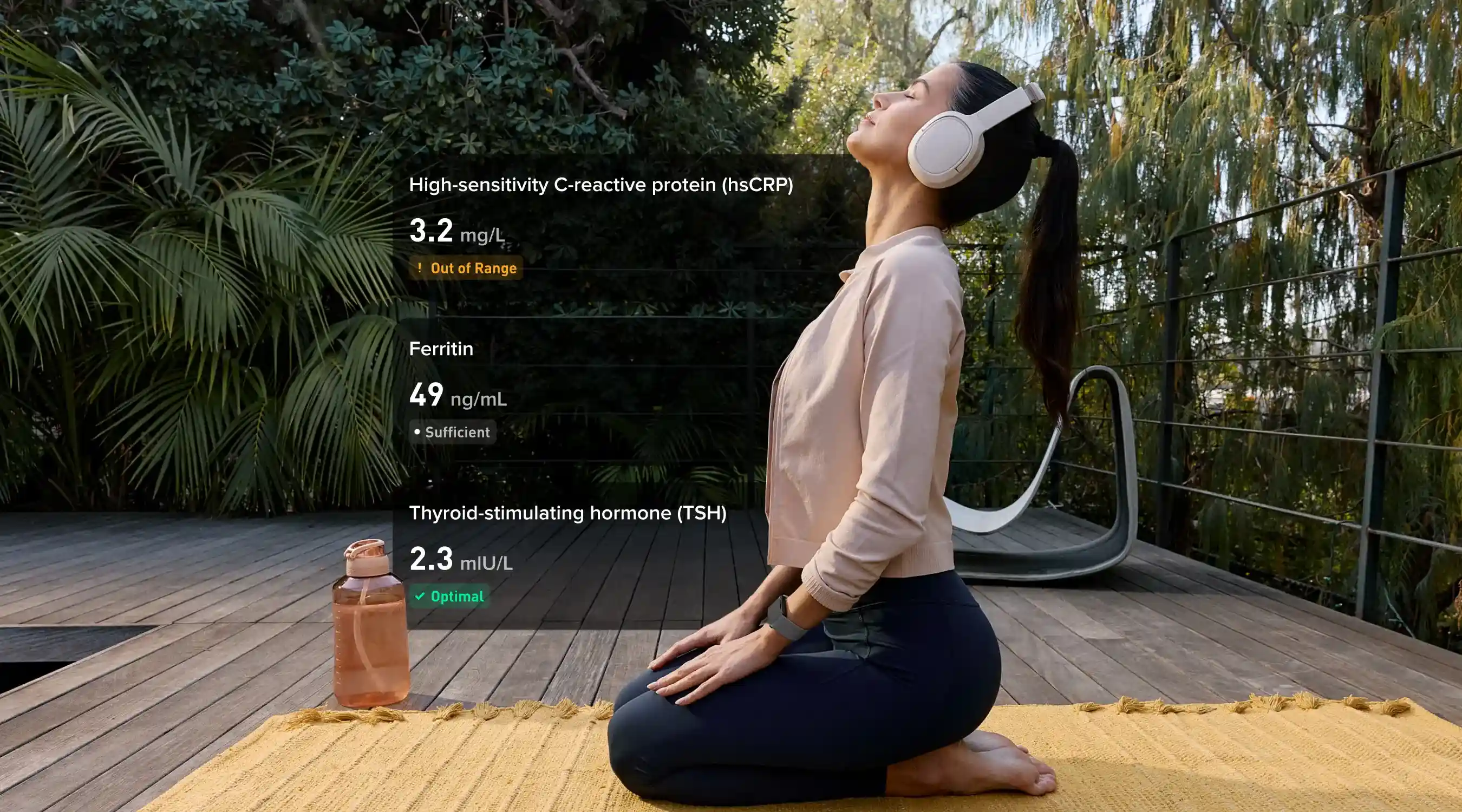
Henderson used C-reactive protein, or CRP, as an example of a marker that becomes much more useful once it is placed in context. In the episode, he explained what makes CRP a fast-moving signal.
“C-reactive protein, it’s a protein that was discovered in the context of the bacteria that causes most pneumonia and causes some meningitis, but it’s made by the liver. It has a half-life of 19 hours. Literally changes basically every day.”
A marker like that can tell you something about systemic inflammation quickly, but only if you can connect it to what else is happening. Henderson’s point is that behavior context turns a number into a clue. Berzin makes a parallel argument from the clinical side. When patients can see their data clearly and connect it to how they felt, the number becomes a useful motivator instead of something abstract.
That is the case for why WHOOP Advanced Labs launched as a way to connect lab diagnostics with continuous monitoring. The same theme runs through Episode 344 of the WHOOP Podcast, which focused on how this data stream fits into the WHOOP app.
If you want to hear Henderson go deeper on data overload, CRP, and why context changes interpretation, listen to the full episode on Spotify.
What you should take away
- Lab data becomes easier to interpret when it sits beside behavior and wearable context.
- CRP is a fast-moving inflammation marker, which makes timing and context especially important.
- Henderson argues that isolated results create confusion, while integrated data creates usable clues.
- WHOOP Advanced Labs is built around that integrated view inside the WHOOP app.
Which daily metrics matter most for long-term health
Once lab data is contextualized, the wearable side of the equation becomes more important. In this conversation, the guests repeatedly come back to sleep, body composition, muscle, and cardiorespiratory fitness as the daily or regularly measured signals that best reflect future function.
Henderson said that if he had to track one ongoing metric for the rest of his life, he would choose sleep quality, especially the combination of duration and consistency. His reasoning is simple: sleep shapes recovery, cognitive function, training capacity, and several hormonal processes that affect what happens the rest of the day.
He gave the clearest version of that hierarchy in one line.
“I like to say the best medicine known to man is sleep. Sleep, the second best is exercise, the third best is estrogen, and the fourth best is Crestor.”
Berzin answered the same question differently and picked total body composition, including bone density, lean muscle mass, and fat mass. Her reasoning was that those measures tell you a lot about future fall risk, metabolic health, and the ability to stay active later in life. She also argued that if she had to choose one training bucket, strength training would get the edge because muscle acts as a major sink for glucose and supports bone health.
Henderson then pushed the exercise conversation toward VO2 max as a marker of future capacity. If your fitness reserve is high in midlife, the decline that comes with aging still leaves you with more function later. Both guests also made room for accessible work such as zone 2 cardio. Capodilupo added an interesting WHOOP observation here, saying internal WHOOP data suggests zone 2 can behave as a recovery modality from an autonomic standpoint as much as an exercise stimulus.
If you want a broader primer on how WHOOP measures Sleep, Recovery, and Strain, Podcast No. 51: Unlocking Human Performance is a useful place to start.
What you should take away
- Henderson puts sleep at the top of the long-term health hierarchy because it shapes recovery, cognition, and training capacity.
- Berzin views body composition, bone density, and lean muscle mass as high-value markers of future function.
- Strength training, VO2 max, and zone 2 work each support longevity from a different angle.
- WHOOP data can help show how sleep and training patterns are changing over time, not only how hard you worked today.
What actually helps behavior change stick over time
Data becomes useful when it leads to experiments people can live with. Both guests argue that sustainable change comes from personal context, repeated feedback, and small adjustments that fit real life.
Berzin talked about the importance of a longitudinal relationship. In her clinic model at Parsley Health, people do better when they understand from the start that health improvement is a path, not a single visit. She also stressed that motivation style varies widely. Some people want information and then want to be left alone to act. Others need a coach, community, or doctor reinforcing the next step. A third group wants to feel that the idea came from them.
Henderson arrived at the same place from quality improvement and clinical care. He said every system produces exactly the results it was perfectly designed to get. In practice, that means poor sleep, weak recovery habits, or repeated food choices are usually outputs of a broader setup, not isolated failures of willpower. He gave the example of a patient with diabetes who lowered hemoglobin A1C from 8.6 to about 6.0 through many small changes, while still keeping sandwiches, ice cream, and beer in his life. The win came from modifying the parts that mattered most, not from trying to become a different person overnight.
Henderson’s quality lens is the most useful quote in this section.
“Every system produces exactly the results it was perfectly designed to get.”
Berzin makes the same point with symptoms. A migraine, acne flare, or fertility problem often has a trigger upstream in hydration, nutrition, hormones, inflammation, stress, or sleep. She described patients whose migraines changed after pulling back from very high coffee intake, and she shared her own story of clearing cystic acne after removing wheat and dairy. The through line is clear: when people see the data, they can run safer, smarter experiments.
That same idea carries into Episode 348 of the WHOOP Podcast, which focuses on using biomarker results to guide day-to-day choices.
What you should take away
- Sustainable behavior change usually comes from small, personalized adjustments that fit a person’s real life.
- Henderson’s systems view explains why habits tend to repeat until the setup around them changes.
- Berzin ties root-cause thinking to practical experiments around food, hydration, sleep, stress, and hormone health.
- Continuous feedback gives people a clearer way to decide which experiments are worth keeping.
The bottom line
- Healthspan in this episode means protecting function, energy, mobility, and independence across future decades.
- Fasting insulin can reveal metabolic strain before hemoglobin A1C shows obvious trouble.
- Lp(a) can surface inherited cardiovascular risk in people who appear healthy and train regularly.
- ApoB, thyroid markers, CRP, nutrient status, and female hormone markers can add early context that a standard physical may miss.
- Lab results become more actionable when they sit beside Sleep, Recovery, Strain, activity patterns, and behavior notes in the WHOOP app.
- Sleep quality, body composition, lean muscle mass, and VO2 max were the daily or repeat metrics the guests tied most directly to future function.
- Sustainable change comes from repeated feedback and personalized experiments, not from a single burst of motivation.
- Root-cause thinking asks what is driving the symptom, which can include stress, hydration, food, hormones, or inflammation.
Frequently asked questions about things discussed in this episode
How does WHOOP Advanced Labs make biomarker data more useful?
WHOOP Advanced Labs makes biomarker data more useful by placing clinician-reviewed lab results next to continuous WHOOP data, so results can be viewed with Sleep, Recovery, Strain, activity, and behavior context in the WHOOP app.
What does WHOOP do for fasting insulin and metabolic health trends?
WHOOP helps you interpret fasting insulin in context by pairing lab results with daily behavior data, which can make patterns tied to sleep, activity, and recovery easier to spot over time.
How does WHOOP support people who want earlier visibility into cardiovascular risk?
WHOOP Advanced Labs supports earlier visibility by adding biomarkers such as ApoB and Lp(a) to a connected view of health, which can help surface risk before symptoms force action.
What does WHOOP track that matters for healthspan outside of bloodwork?
WHOOP tracks signals such as Sleep, Recovery, Strain, and cardiorespiratory fitness trends that Henderson and Berzin linked to future function, training capacity, and day-to-day energy.
How does WHOOP help reduce data overload?
WHOOP reduces data overload by keeping biometrics, lab results, and logged behaviors in one place, which makes trends easier to interpret than scattered reports and screenshots.
What does WHOOP show about sleep and long-term health?
WHOOP shows sleep duration, sleep consistency, and related recovery trends that Henderson described as central to long-term function, especially because sleep shapes how well training, hormones, and recovery work together.
How does WHOOP support behavior change after you get lab results?
WHOOP supports behavior change by giving people repeated feedback on the habits they test, which makes it easier to keep the changes that move a marker in the right direction and drop the ones that do not.
When biomarker results, sleep patterns, recovery trends, and behavior logs live in the same place, WHOOP can make the idea of healthspan concrete enough to guide the next decision.
Related Articles
How WHOOP Advanced Labs connects bloodwork to daily coaching

Topics
- Health & Wellness
- Biomarkers
- Behavior Impact
WHOOP Advanced Labs: Lab results meet daily coaching

Topics
- Health & Wellness
- App & Features
- Biomarkers
Health Biomarkers: 10 Key Metrics with WHOOP Advanced Labs
Topics
- Biomarkers
- Metabolic Health
- Heart Health
