Topics
- Article
- Running
- Strain
Marathon des Sables: Strain, Sleep, and Recovery Data
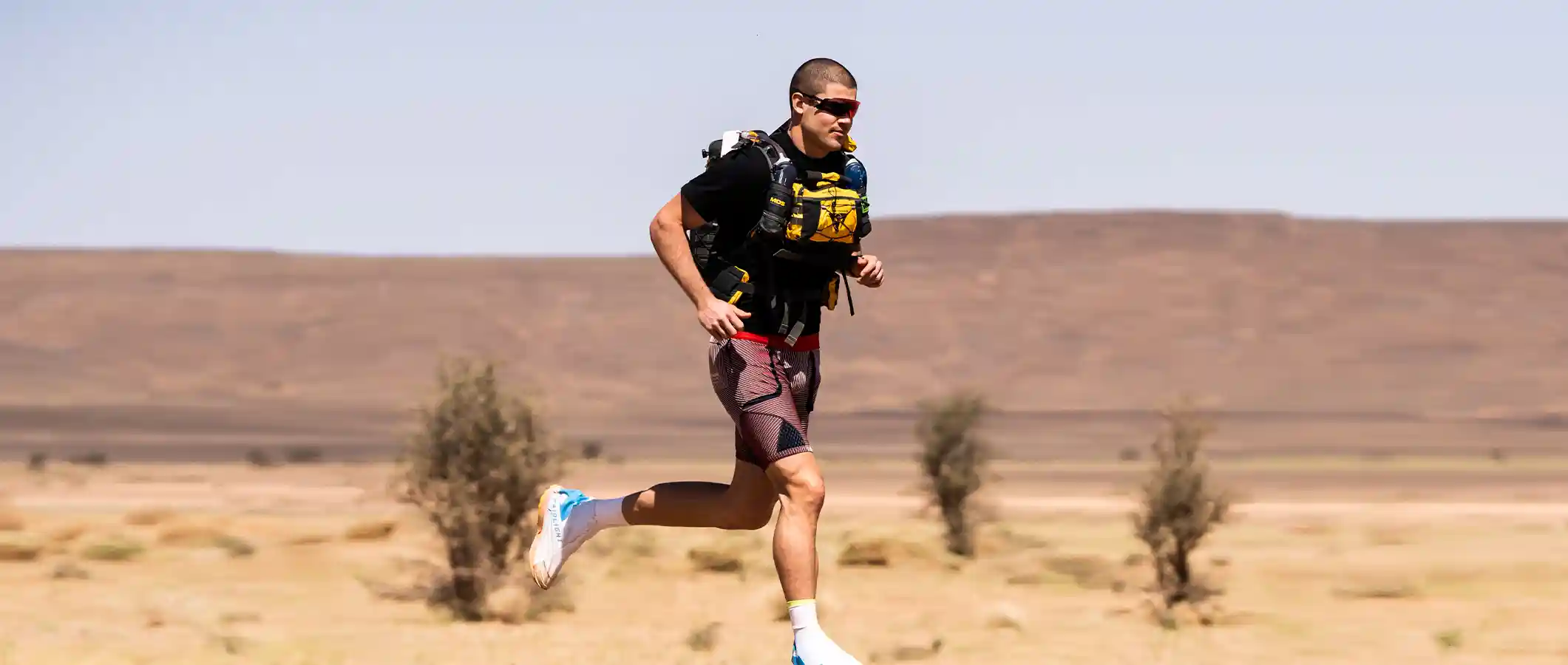
William Goodge just completed the Marathon des Sables, a week-long 144-mile ultramarathon through the Sahara Desert. Here's what we saw in his WHOOP data.
William Goodge is a WHOOP member and ultrarunner, who ran 48 marathons in 30 days while raising money to fight cancer in memory of his late mother. William's latest superhuman feat? Conquering the Marathon des Sables, widely regarded as the toughest foot race on the planet.
What is the Marathon des Sables?
If you type "Marathon des Sables" into your search browser, the next word that likely follows is "deaths" (3 participants have died during it in the past 36 years). The race lasts 7 days and consists of 6 stages roughly the length of one marathon each—all through the Sahara Desert. Temperatures may reach 130 degrees Fahrenheit, and runners must carry all their food and everything else they need on their backs.
The list of required supplies includes a compass (50-mile-an-hour sand storms can create zero visibility), an anti-venom pump in case of snake bites, and a mirror and whistle to signal for help. Water is provided at regular checkpoints every 5-9 miles. Race participants sleep in large communal tents at night.
Preparing for the Marathon des Sables
Preparing for an event like the Marathon des Sables is a long-term commitment that goes far beyond running. Your training must address extreme heat, difficult terrain, multi-day fatigue, and the physical burden of carrying everything you need on your back.
Building a significant aerobic base is foundational. You need the cardiovascular capacity to handle marathon-distance efforts day after day. This means accumulating consistent weekly mileage over months, gradually increasing your long runs, and incorporating back-to-back training days to simulate the cumulative fatigue of a stage race.
Monitoring your VO₂ Max can help you track improvements in your aerobic fitness and ensure your training is moving you in the right direction.
Strength training is equally critical. Running on soft sand and climbing rocky jebels while carrying a pack demands muscular endurance that road running alone won't develop. Focus on exercises that build core stability, leg strength, and posterior chain power.
Weighted pack training—starting light and progressively increasing load—prepares your body for the specific demands of the race.
Heat acclimatization is perhaps the most underestimated aspect of preparation. Your body needs time to adapt to performing in extreme temperatures. This can include training in hot weather, running in extra layers to simulate heat stress, or spending time in a sauna post-workout.
These methods help improve your body's ability to sweat efficiently, lower core body temperature, and reduce cardiovascular strain in the heat. Tracking your Strain and Recovery during this phase can help you understand how your body is adapting and prevent overreaching.
A physiological look at the Sahara: William Goodge's WHOOP data
"This was a new challenge and experience for me," William told us. "So much of it was climbing jebels (mountains), running on soft sand, and going over dunes. Aside from the physical toll of completing those distances carrying a pack that started at 12.5 kgs, a lot of mental energy was used simply trying to find the most efficient route."
William's strain topped 20 for each of the first 4 stages as he burned an average of nearly 5,750 calories per day. Here are his daily stats from the race:
William carrying everything he needed for the 7-day Sahara desert marathon.
William had a 20.6 strain and burned 7,401 calories on Day 4, which was the longest stage at 47 miles.
"Once the days' running had finished, there really was nothing to do other than eat and get an early night, which meant the hours I spent in bed were actually much higher than normal," he said. "But in an environment where there was constant noise from the other competitors and my tent mates, my sleep was far more disturbed than usual."
Strain, Sleep, and Recovery in the desert
Below is a two-week sample of William's daily strain and recovery. Low strain prior to the race enabled him to hit the starting line with a nice string of green recoveries, including 88% for Stage 1. William managed to keep his recovery in the green for the second day as well, but after that the immense strain and harsh conditions quickly began to take their toll.
William got his recovery back to 87% just two days after completing the grueling desert ultramarathon.
The day of "rest" did William little good following the race's brutal 4th stage (47 miles, a 20.6 strain and 7,401 calories burned), as his Day 6 recovery was just 6%. "The long stage on Day 4 had a 36-hour time window," he explained. "Even though myself and a lot of competitors finished within 16 hours, on the fifth day people were constantly in and out of the tent recovering or still finishing off. It was my worst night's sleep of the competition."
However, William pushed through and completed the race with a time of 35 hours, 23 minutes and 55 seconds. Amazingly, it only took William two days of post-race recuperation (with strains below 5 each day) to get his recovery back to green—and it's a good thing too, because he's running the Zurich marathon on April 10.
How WHOOP can help you achieve your endurance goals
William's data provides a clear picture of the physiological demands of extreme endurance. Understanding how your body responds to intense training and competition is critical for optimizing performance and recovery. By quantifying your daily Strain, Sleep, and Recovery, you can make more informed decisions about your training, prevent overreaching, and ensure you are adapting effectively to the stress you're placing on your body.
Whether you are preparing for an ultramarathon or your first 5k, these insights are fundamental to reaching your potential. Continuous monitoring allows you to see patterns over time and adjust your approach based on objective data.
Frequently asked questions about the Marathon des Sables
How difficult is the Marathon des Sables?
The Marathon des Sables is widely considered one of the most difficult footraces on Earth. Its challenge comes from running approximately a marathon a day for six days, extreme desert heat, difficult terrain including sand dunes and rocky jebels, and the requirement to be self-sufficient by carrying all your food and gear for the week. The physical and mental demands are immense, and the environment is unforgiving.
Can anyone run the Marathon des Sables?
While the race is open to all entrants and does not require elite status, it demands a very high level of physical and mental preparation. Participants range from professional ultrarunners to determined amateurs who have dedicated significant time to training. Completing it is an achievable goal for non-elite athletes, but it requires a serious and structured approach to training and preparation.
How do you train for the heat in the Marathon des Sables?
Heat acclimatization is a critical part of training. Athletes often use specific protocols in the weeks leading up to the race to help their bodies adapt. This can include training in hot weather, running in extra layers to simulate heat stress, or spending time in a sauna post-workout.
These methods help improve the body's ability to sweat efficiently, lower core body temperature, and reduce cardiovascular strain in the heat. The adaptation process typically takes 10-14 days of consistent heat exposure.