Topics
- Post
- Member Stories
- Running
Podcast No. 93: Chris Mosier, Trans Athlete Who Changed the Olympic Games
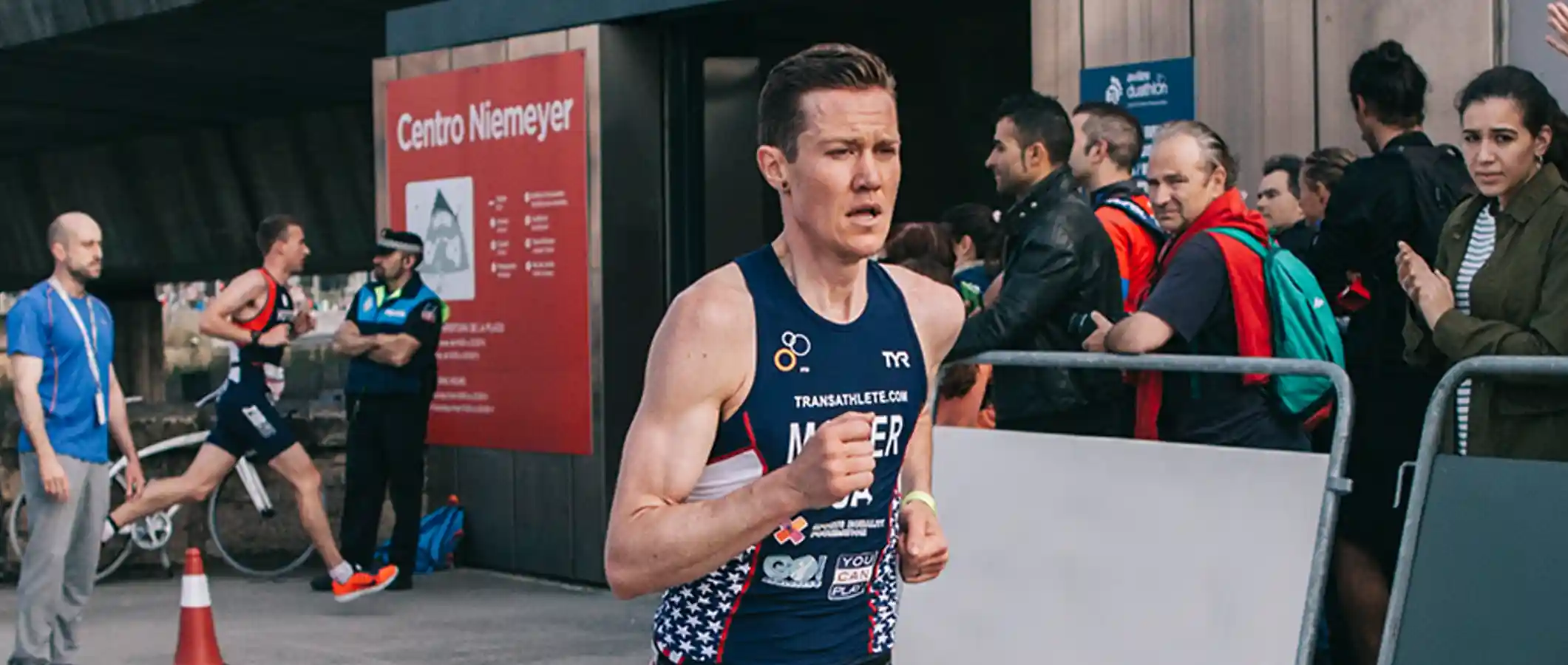
On this week’s episode, our VP of Performance Kristen Holmes returns for an inspiring and important conversation with Chris Mosier.
Chris is a remarkable person, an elite athlete, and a true trailblazer in the world of sports. He was the first trans man to make a U.S. national team, a feat he accomplished in 2015 when he earned a spot on Team USA’s sprint duathlon team. But before he could compete, Chris had to challenge the International Olympic Committee’s policy on trans athletes. He served as the catalyst for the eventual change in IOC rules. The first trans athlete to ever compete at the Olympic Trials in any sport, Chris is now a 6-time member of Team USA. He was also the first trans athlete to be featured in his own Nike commercial and to appear in the ESPN Body Issue. Chris discusses the many challenges he faced, and overcame, throughout his life. He and Kristen also touch on a number of difficult issues, including substance abuse and the prevalence of suicide in the trans youth community. I think you’ll take a lot away from this episode and we appreciate Chris’ willingness to share his story.
Chris Mosier Podcast Show Notes:
4:10 - Advocating for Trans Athletes. “It was a very clear, distinct choice that I made [to become an advocate for trans athletes]. I knew in 2009 when I was still participating with women that when I transitioned I would be the first. I didn’t see anyone who looked like me who was participating in sports. I didn’t see any trans men competing with men, which is what I wanted to do. And not just compete, I wanted to compete at a high level. I didn’t want to lose my competitiveness to be my authentic self.” 7:01 - Transitioning. “I was terrified to come out and to start my transition because I didn’t want to lose sport. It was that important to me. … [But I realized] regardless of what would happen in sport, even if I couldn’t play anymore, I had to transition because I quite literally would not be here on this earth if I didn’t. It was truly a matter of life and death for me. Sport took a second place to my survival at that point.” 10:50 - The Breaking Point. Chris details some of his emotional struggles before his transition. “It just came to a point where I said, ‘I can’t do this anymore. I actually can’t picture myself being here for my next birthday if something doesn’t change.’” 11:44 - The Difficult Path to Finding Yourself. “You don’t know who you are if you don’t see a reflection of yourself. If there’s no example and you don’t have access to the terminology and the language to describe how you’re feeling, then how do you process that?” 14:47 - Supporting Trans Youth. “A lot of times we have two options: It’s you either have a trans kid or you have a dead kid. I don’t say that for shock value, I say that because the suicide statistics for the trans community are outrageous. For many of us, the thought crosses our minds that this world is not set up for us.” 21:32 - Sports and Life Lessons. “For me, sport was where I found so many positive values and lessons. I think all people should have access to that. Particularly, when we’re talking about youth sports, what is the goal? It’s to create better people. It’s to provide young people an opportunity to move their bodies, to have enriching experiences, to connect to their peers. … Instead of thinking about how we can exclude a certain group of people, how can we think about including all people?” 24:31 - Overcoming Health Challenges. Chris explains how he recovered from two mini-strokes in college as part of his journey to becoming an elite athlete. “I didn’t think that I would reach my 25th birthday. I didn’t see myself getting married. I didn’t see myself having a relationship. I certainly didn’t see myself here sharing my story today. There was no future for me.” 26:14 - Finding Running. “After I had these two mini strokes, I really got reset. I couldn’t run a mile. I really struggled to make a recovery. I saw a Chicago marathon banner and said, ‘I’m going to do that.’ My friends said, “You can’t run a mile! Good luck with that.’ And that was really the start of this athletic journey. … It was reconnecting with myself and my body.” 28:35 - Testing Your Limits. “We are capable of so much more than we believe.” 31:08 - Painkiller Abuse. “After my stroke, I had a really hard time with painkillers. It wasn’t consistent use, but it was definitely abuse when I was taking them. … I was really, really troubled by the way that I was using painkillers when I did have them. I wasn’t numbing my pain, I was numbing my pain. My life pain.” 32:31 - Motivation. Chris explains what motivates him as an athlete, detailing a New York Times article that painted him as a “middle of the pack” competitor. “I remain deeply offended! Every single day I woke up and thought about that. I am not going to be out-worked.” 33:50 - Using WHOOP. “The best part [of WHOOP] has been my sleep. I’m really trying to hit sleep numbers. It’s a challenge to myself to get improved recovery. … Trying to have that benchmark for sleep has been the best part of the WHOOP for me.” 36:07 - Getting Into Racewalking. “It’s so hard. It’s so much harder than running. … There’s so much that I have to think about in terms of technique and also it’s just a movement that my body is just not used to. I’ve found it to be an incredible challenge, especially as an adult beginner.” Despite picking up racewalking only a year and a half ago, Chris qualified for the Olympic trials. 37:52 - Absurd Strain Data. “My average [day] strain is 20.2. … I have very heavy days.” 39:03 - Tracking CBD Use. Chris shares what he’s learned by using the WHOOP Journal, including the profound impact he’s found while using CBD. “On the days that I take CBD, I have, on average, 1 hour and 14 more minutes of sleep than if I don’t. That is probably the most mind-blowing statistic of everything that I’ve learned about myself in my training and my recovery through using WHOOP.” 41:49 - Go-To Book. The Champion’s Mind: How Great Athletes Think, Train, and Thrive. “It’s the book that I listen to before every single race that I do. I play this book on repeat on my way to the race. It’s just so grounding. I recommend it to all of my athletes.” 43:05 - A Motto to Live By. “Every day, you have a shot at making history.” Chris goes on to say that people should “never limit [their] own greatness to make other people more comfortable.” Connect with Chris on Instagram and on Twitter.