Topics
- Post
- Member Stories
How to build a training brand and protect founder performance
Originally published on May 29, 2019
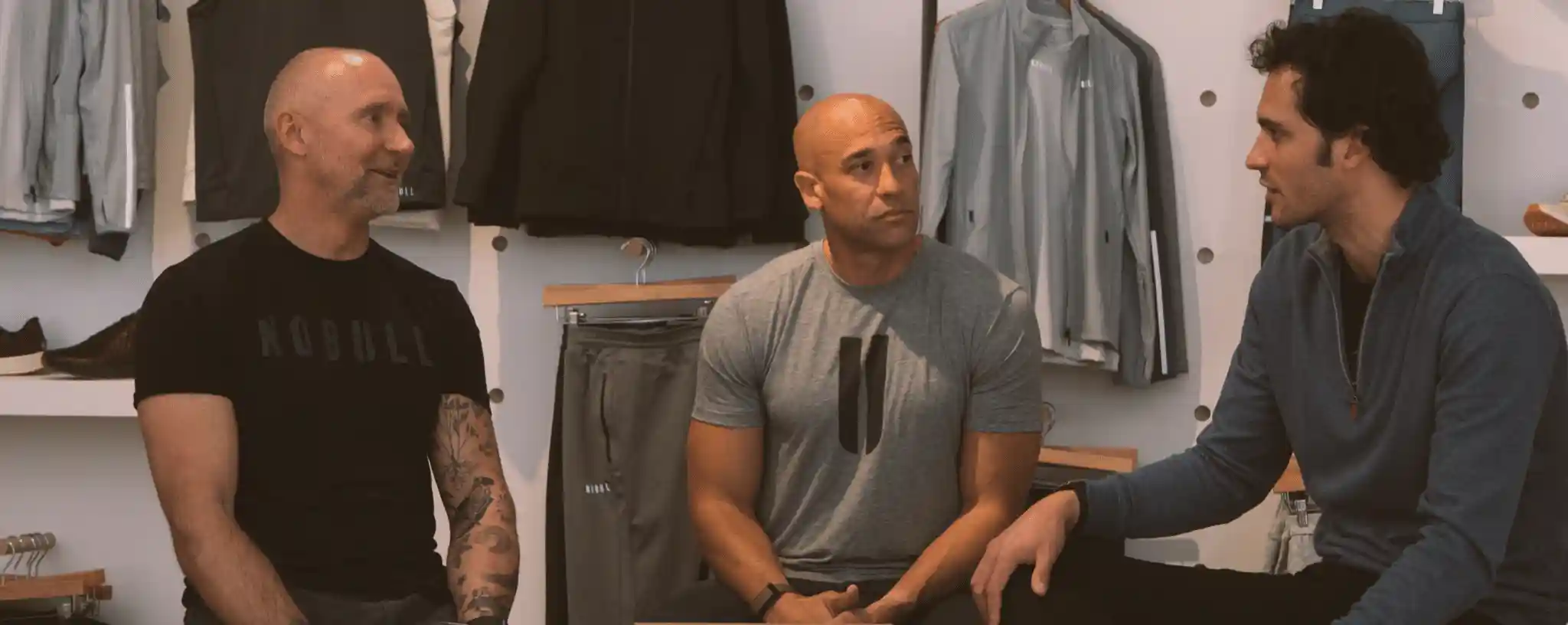
Building a training brand without outside investors takes clear product judgment, defined founder roles, and routines that protect recovery. Michael Schaeffer and Marcus Wilson, co-founders of NOBULL, built the company by pairing deep footwear experience with first-hand knowledge of CrossFit training and the demands that come with long workdays.
In Episode 25 of the WHOOP Podcast, Schaeffer and Wilson explain how they found the NOBULL identity, why they pushed back launch after seeing weak early prototypes, and which habits helped them perform as founders. The conversation also shows how WHOOP fit into that process, especially around sleep, recovery, fasting, travel, and day-to-day self-awareness.
Note: This article covers WHOOP 3.0. For the latest hardware, see WHOOP.
To listen to episode 25 in full, head to the WHOOP Podcast on Spotify.
What helped NOBULL find a product idea that fit the market?
NOBULL started with founder-product fit. Before Schaeffer and Wilson had a final shoe, they already had a clear point of view on training, brand identity, and how they would work together.
The two first connected while Schaeffer was interviewing at Reebok after working at Puma. They stayed close after Adidas acquired Reebok and their team changed, and that long runway mattered once they decided to build together. Wilson focused on business, marketing, finance, and bank relationships. Schaeffer owned the look, feel, and product side. Just as important, each could challenge the other without blurring responsibility.
Wilson described that split in practical terms:
“Michael handles kind of all things, the look and feel of the brand. I handle more of the business side, the marketing side, finance. Most importantly we trust each other completely.”
That structure gave them room to move fast in a crowded category. It also kept the brand close to a real training community instead of chasing a broad market from day one. Their entry point was CrossFit, a space both founders understood through daily practice and through relationships built at CrossFit New England. That same clarity shows up in other founder conversations on the Locker, including Entrepreneurship & Future of Technology.
What you should take away
- Strong founder-product fit can be a better starting point than trend chasing.
- Clear ownership between creative and business work can speed up decisions.
- Trust between founders becomes more valuable when the company is self-funded.
If you want to hear Wilson unpack how he and Schaeffer split creative and business responsibilities, listen to the full episode on Spotify.
How do you turn brand identity into a training shoe?
Once NOBULL had a name and a point of view, the product brief became simpler. Schaeffer said the brand identity itself acted as a design filter, which meant removing anything that did not help performance.
That mattered in CrossFit, where one shoe has to cover several demands in a single workout. A CrossFit workout, or WOD, can include lifting, jumping, rope climbs, and short runs. Schaeffer and Wilson wanted one training shoe that felt stable, durable, and simple, without extra layers that added bulk.
Schaeffer summed up the functional brief this way:
“There’s a lot of various movements that you’re doing, so you need a shoe that is stable, you need a shoe that is durable, you need a shoe that you can do short runs in. And so really, we just stripped it down to what we felt was kind of the bare essentials.”
That stripped-down approach also changed the feel of the product. Instead of building durability by stacking more pieces onto the upper, the team worked toward a single shell with protective texture built into the material. Fewer layers reduced pressure points and improved comfort. That same training context comes up in Marcus Filly, where the conversation also centers on matching equipment and training decisions to real-world demands.
What you should take away
- A brand identity can work as a product filter when it is specific enough.
- CrossFit footwear has to balance stability, durability, and short-run versatility in one shoe.
- Simpler construction can improve comfort when durability comes from material choice instead of extra layers.
If you want to hear Schaeffer go deeper on how NOBULL designed for CrossFit demands, listen to the full episode on Spotify.
Why would a founder delay launch after spending their own money?
Delaying a launch can be the right call when the product misses the standard. Schaeffer and Wilson made that decision after opening early prototypes in 2014 and realizing the shoes were far from ready.
They had already invested their own savings, talked up the launch to friends in the industry, and planned to show the product around the CrossFit Games in Carson. Then the box arrived at a hotel in Manhattan Beach, and the prototypes were, in Schaeffer’s words, “absolutely horrific.” The choice was simple and painful: launch a weak product because the money was already spent, or wait another year.
Wilson explained the decision like this:
“We made a very difficult decision to push the launch out to the next year until we had something that we were proud of. It was probably the hardest but best decision that we made.”
They stayed with the same factory network, improved materials, tightened quality control, and learned the difference between perfect and ready. Schaeffer put it well during the episode: if you wait for perfect, you may never launch anything. That lesson lines up with other Locker founder stories, including Marc Randolph, Co-Founder of Netflix, where product iteration and early failure also shaped the business.
What you should take away
- Self-funded companies still need quality standards that override sunk costs.
- A one-year delay can protect brand trust if the first product is weak.
- “Proud enough to launch” is a better test than chasing perfection.
If you want to hear Wilson unpack the prototype setback and the one-year delay, listen to the full episode on Spotify.
How can WHOOP help founders manage sleep, recovery, and fasting?
WHOOP helped Wilson and Schaeffer connect work habits to physiology. The clearest shift was around sleep, but the conversation also covered late meals, alcohol, fasting, resting heart rate, and daily self-awareness.
Wilson said WHOOP made it obvious how little sleep he was getting in the early startup phase, which pushed him to reprioritize recovery. He also built a useful rule for himself: before checking his Recovery score in the WHOOP app, he first asks how he feels. That keeps the data grounded in body awareness instead of emotion driven by one number.
As the discussion moved from sleep to nutrition, Wilson gave the most specific example:
“How quickly I reach my lowest resting heart rate is much, much faster when I’m fasting. I find I get the best sleep when I do like a 36-hour fast.”
Schaeffer described a different routine, a weekly 24-hour fast from Sunday dinner to Monday dinner. Neither founder claimed there is one best diet for everyone. Their point was narrower and more useful: use consistent behavior, then watch what changes in sleep, resting heart rate, and recovery. For a deeper look at how WHOOP frames those signals, see What is WHOOP? and The Story of WHOOP.
What you should take away
- WHOOP can reveal sleep debt that feels normal during a busy startup phase.
- Checking how you feel before looking at Recovery can keep data in context.
- Repeated routines, including fasting or changing meal timing, are easier to evaluate when you track sleep and resting heart rate over time.
If you want to hear Wilson go deeper on sleep, fasting, and Recovery, listen to the full episode on Spotify.
What habits help entrepreneurs travel, focus, and stay creative?
The habits in this episode are simple. Get onto the new time zone fast, move once you arrive, protect a short meditation routine, and keep some distance between creative work and the exact category you sell in.
Wilson said he aims to get onto local time quickly when traveling and pairs that with exercise after landing. His daily morning routine includes meditation, usually 15 to 20 minutes with Headspace. At the time of recording, he said he had logged more than 550 straight days. Schaeffer described a different way of protecting performance: getting outside on weekends, staying active, and avoiding the trap of only looking at shoes for inspiration.
Wilson gave the clearest detail on the meditation piece:
“When I get up, I meditate for 15 to 20 minutes.”
Schaeffer said his creative inputs come from architecture, furniture, cars, motorcycles, and outdoor gear. That wider lens even shaped shoe details, including a midsole texture inspired by a vase on his breakfast table. For founders, the lesson is practical. A repeatable focus routine helps decision-making, and better creative work often comes from inputs outside the immediate category.
What you should take away
- Travel routines work better when they combine local-time adjustment with movement.
- A 15 to 20 minute meditation habit can be realistic even during heavy work periods.
- Creative work improves when inspiration comes from outside your own category.
If you want to hear Schaeffer unpack travel, meditation, and creative routines, listen to the full episode on Spotify.
Where is training footwear technology heading next?
Schaeffer sees the next useful advances in footwear coming from lower-waste construction and more customizable production. He focused on knitting and 3D printing, two technologies that can change how a shoe is built without adding visual noise.
Knitted uppers let designers create different zones for support, breathability, and protection in one piece. That reduces waste compared with cutting shapes out of larger materials. Schaeffer also pointed to 3D printed bottom units as a longer-term shift because they can support customization and reduce waste by adding material only where it is needed.
Looking ahead, Schaeffer framed it this way:
“We have a knitted running shoe. That’s a super progressive trend in the marketplace right now. 3D printing is a huge one. I think that’s where it’s going over time.”
Wilson connected that product view to distribution. Direct-to-consumer brands can speak to a narrower audience, respond faster, and stay closer to customer feedback. That is part of why customer service mattered so much to the founders. Early on, they handled it themselves, and even angry messages taught them something useful about demand, fit, and expectations.
What you should take away
- Knitted uppers can reduce waste while creating support and breathability in one construction.
- 3D printing may matter most for customization and material efficiency.
- Direct-to-consumer brands can learn faster when founders stay close to customer feedback.
If you want to hear Schaeffer go deeper on knitting, 3D printing, and customer feedback, listen to the full episode on Spotify.
The bottom line
- NOBULL grew from founder-product fit, not from a broad market plan built far from the training floor.
- Michael Schaeffer and Marcus Wilson divided creative and business ownership clearly, which helped them move fast and challenge each other productively.
- Delaying a launch by one year protected the brand after early prototypes failed to meet the standard.
- NOBULL designed its first shoe around CrossFit demands, including stability, durability, and the ability to handle short runs in a single workout.
- Wilson used WHOOP to see how little sleep he was getting during the startup phase and to reprioritize recovery.
- Fasting became more measurable when Wilson tracked resting heart rate and sleep response through WHOOP.
- Meditation, local-time adjustment after travel, and off-category creative inputs all supported steadier founder performance.
- Schaeffer sees knitted uppers and 3D printing as two of the most useful directions in training footwear.
Frequently asked questions about things discussed in this episode
How does WHOOP help founders manage recovery during long workweeks?
WHOOP helps founders manage recovery by combining sleep, heart rate variability, resting heart rate, and recent strain into a daily Recovery score. That daily view can make sleep debt and burnout patterns easier to spot.
What does WHOOP show about late meals or alcohol?
WHOOP shows how late meals or alcohol can change sleep quality, resting heart rate, and next-day recovery. Wilson described using WHOOP to remove guesswork from those patterns.
How does WHOOP fit with fasting experiments?
WHOOP fits with fasting experiments by showing whether changes in meal timing line up with better sleep, lower resting heart rate, or stronger recovery trends. Schaeffer and Wilson both used that feedback to judge routines over time.
What does WHOOP do for people who travel across time zones?
WHOOP helps people traveling across time zones watch how sleep and recovery respond after flights, schedule changes, and late arrivals. That feedback can make it easier to test routines such as training after landing or getting onto local time quickly.
How does WHOOP help you compare how you feel with what your body shows?
WHOOP helps by giving an objective daily view that you can compare with your own body awareness. Wilson said he asks himself how he feels before checking Recovery so the score adds context instead of driving the mood.
What does WHOOP measure during sleep that matters for recovery?
WHOOP measures sleep and tracks signals such as heart rate variability and resting heart rate that support recovery insights. Those trends help people see whether training, stress, nutrition, or travel are showing up overnight.
For founders balancing hard training with hard work, WHOOP makes it easier to see whether sleep, fasting, travel, and late nights are supporting performance or quietly dragging it down.