Topics
- Article
- Heart Rate
- Training & Exercise
Heart Rate Zones Explained: Optimize Training

Learn how to use heart rate zones to guide your training intensity, build cardiovascular fitness, and balance effort with recovery. This guide explains what zones are, how they're calculated, and how to apply them to reach your goals.
What are heart rate zones?
Heart rate zones measure exercise intensity based on your maximum heart rate. Each zone represents a percentage range of your max heart rate, and training within a specific zone helps you achieve different fitness goals.
Think of them as a guide for your cardiovascular system — they help you understand whether your effort is best suited for building endurance, improving peak performance, or facilitating recovery. By paying attention to your zones, you can make your training more precise, ensuring every workout has a purpose.
How WHOOP calculates your personalized heart rate zones
WHOOP uses the heart rate reserve (HRR) method to calculate your personalized heart rate zones. The formula is:
Target HR = ((Max HR - Resting HR) x % Intensity) + Resting HR
By incorporating both your maximum heart rate and your resting heart rate, this formula accounts for your current fitness level, producing zone boundaries that are specific to your physiology.
For example, for someone with a Max HR of 200 and a resting HR of 50:
- Zone 2 lower bound: ((200 - 50) x 0.60) + 50 = 140 bpm
- Zone 2 upper bound: ((200 - 50) x 0.70) + 50 = 155 bpm
Using only Max HR percentages, that same person's Zone 2 would have been 120-140 bpm. The HRR method adjusts zone boundaries upward, offering a more tailored approach.
Calculating HR Zones based on Max HR alone is still common across other fitness trackers and gym equipment, but its main drawback is that it does not account for fitness level. Two people of the same age can have very different resting heart rates, and the HRR method captures that difference.
WHOOP automatically adjusts your heart rate zones monthly based on changes to your resting heart rate.
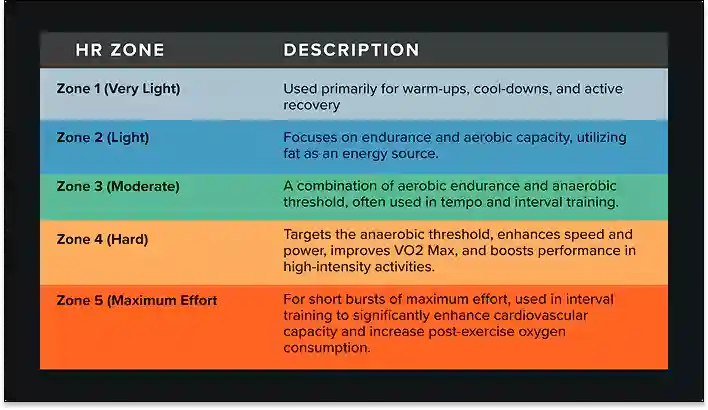
The five heart rate zones explained
WHOOP breaks down your activity into five heart rate zones. Understanding the purpose of each helps you train smarter and recover more effectively.
Zone 1: Light (50-60% intensity)
This is a very light intensity zone used for active recovery. Training here helps promote blood flow to muscles, clearing metabolic waste without adding significant stress to your body. You should be able to hold a full conversation with ease.
Zone 2: Metabolic flexibility (60-70% intensity)
This is your endurance zone, ideal for building a strong aerobic base. Workouts in this zone are sustained and feel relatively comfortable. Your body becomes more efficient at using fat for fuel, which is crucial for long-duration activities.
While training at 60-70% of your max HR technically burns more fat than more intense exercise, losing weight is actually about burning calories. You can sustain activity longer at a lower heart rate, but you'll burn more calories when you increase your exertion.
Zone 3: Endurance (70-80% intensity)
This is a moderate intensity zone where you improve cardiovascular fitness and muscular endurance. You're breathing more heavily and can only speak a few words at a time. This zone helps your body learn to manage lactate, pushing back the point of fatigue.
Zone 4: Threshold/tempo (80-90% intensity)
This is a high-intensity, anaerobic zone. Efforts here are hard and can't be sustained for long. Training in this zone improves your VO2 max and your ability to perform at a high level for longer durations.
Zone 5: Max effort (90-100% intensity)
This is your maximal effort zone, reserved for short, all-out bursts. This level of intensity helps develop peak power and speed. It's unsustainable for more than a minute or two and should be used strategically in your training.
How to use heart rate zones to optimize training and recovery
Each HR zone has a general benefit, but balance is key. Over a given week, you should aim to spend roughly 75% of your training time in the lower Zones 1-3 and 25% in the higher Zones 4-5.
To promote a healthy cardiovascular system, general guidelines are 90+ minutes per week of moderate-intensity aerobic activity (Zones 1-3) and 30+ minutes per week of vigorous aerobic activity (Zones 4-5).
A balanced weekly plan might include:
- Zone 1: Recovery sessions and cooldowns
- Zone 2: 2-3 times per week for aerobic base building
- Zone 3: 1-2 times per week for endurance
- Zone 4: 1-2 times per week for performance gains
- Zone 5: Sparingly, roughly once per week for peak efforts
To spend more time in specific zones, adjust your exercise intensity to match your target. Zones 4-5 may require high-intensity intervals such as sprints, while Zones 1-3 may require purposefully slower-paced jogging or walking.
WHOOP provides a daily Strain Target based on Recovery. On high-Recovery days, you can push into Zones 4 and 5. On low-Recovery days, focusing on Zones 1 and 2 is more beneficial.
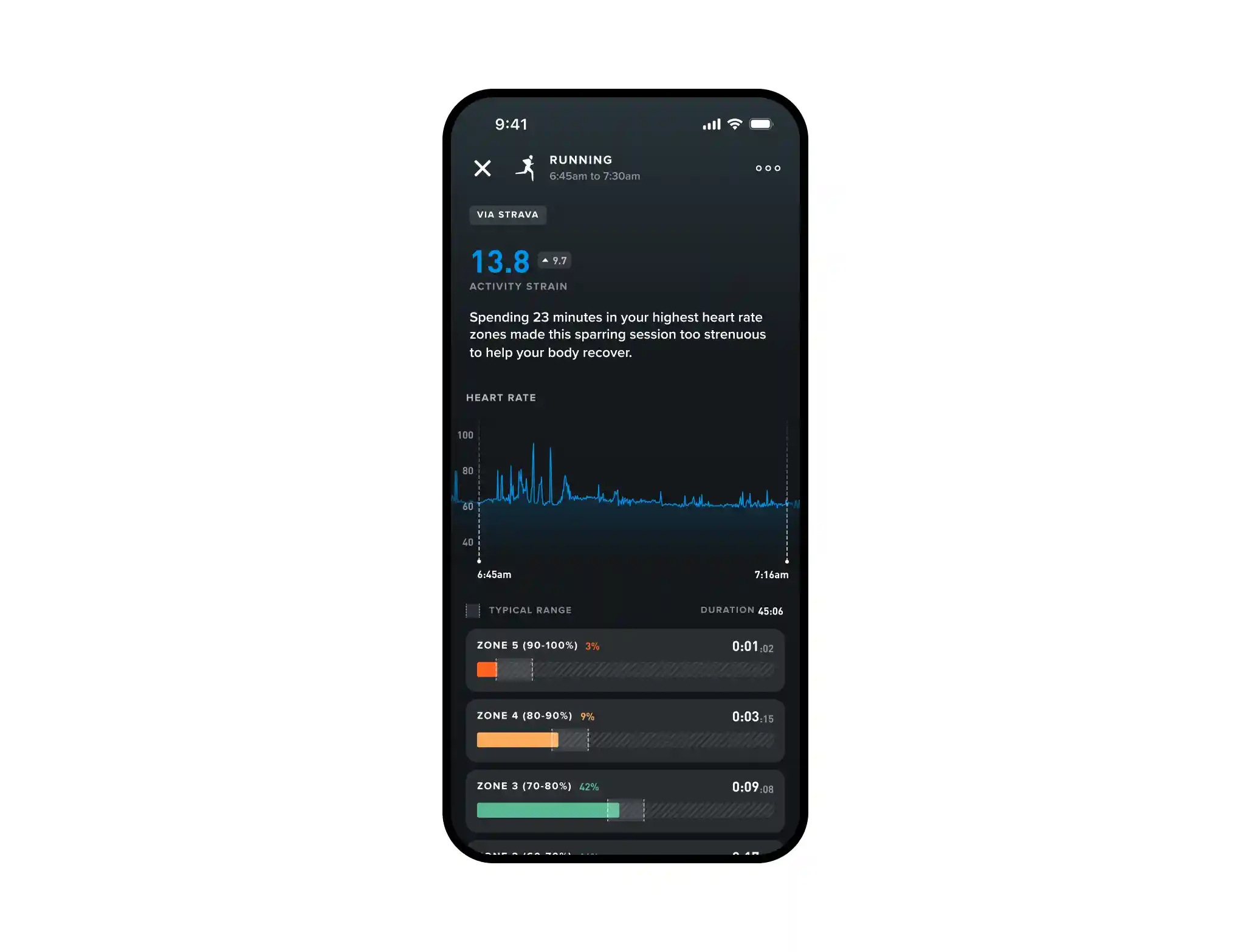
You can set weekly goals for time in Zones 1-3 and Zones 4-5 through your Weekly Plan. To see your HR Zone trends, navigate to any Trend, tap the dropdown at the top, and select any of the HR Zone trends.
Go beyond zones to unlock your potential
Heart rate zones provide a powerful framework for your training, but they are just one piece of the puzzle. By combining zone training with insights into your daily Sleep, Strain, and Recovery, you get a complete picture of your body's readiness to perform. This holistic approach allows you to make smarter decisions, train with purpose, and see consistent progress over time.
Frequently asked questions about heart rate zones
What is a good heart rate range for my age?
While age-based formulas exist, a 'good' heart rate is highly individual and depends on your fitness level, genetics, and other factors. A more useful approach is to understand your personal ranges, including your resting heart rate and how your heart responds to different levels of exertion. Continuous monitoring helps establish your unique baseline.
What zone should I be in when exercising for weight management?
For weight management, the most important factor is burning more calories than you consume. While Zone 2 uses a higher percentage of fat for fuel during the activity, higher-intensity workouts in zones 3 and 4 burn more total calories in a shorter amount of time. A balanced approach that includes both building an aerobic base in Zone 2 and pushing intensity in higher zones is most effective.
Is zone 3 considered vigorous exercise?
Zone 3 is typically classified as moderate-intensity exercise. It's a challenging but sustainable pace where you are noticeably increasing your heart rate and breathing, but you are not yet at a point of significant discomfort. Vigorous exercise usually begins in Zone 4.
How can I manually edit my heart rate zones?
You can edit your HR Zones in the WHOOP app by going to:
- iOS: More > App Settings > Activity Settings > Heart Rate Settings
- Android: More > Activity Settings > Heart Rate Settings
Toggle on "Manual Heart Rate Zones" and customize your zones as needed. You can also edit your Max HR from the same screen.
Will changing my heart rate zones affect Strain calculation?
Changing your HR Zones won't impact how Strain is calculated. However, modifying your Max HR will affect Strain and calorie calculations.
Do heart rate zones change as my fitness improves?
WHOOP automatically adjusts your HR Zones monthly based on changes to your resting heart rate.
Why does WHOOP suggest different heart rate zones than my previous fitness tracker?
WHOOP uses heart rate reserve, an industry-standard HR Zone calculation that factors in both maximum and resting heart rates, providing a more personalized reflection of your fitness.
What if my heart rate is lower or higher than expected during a workout?
First, make sure your WHOOP is worn snugly on your wrist or body to ensure accurate readings. Various factors such as stress, fatigue, hydration, and sleep can impact your heart rate. If your heart rate consistently falls outside the expected range, you may need to adjust your workout intensity or review your Recovery data. If the issue persists, consider consulting your doctor for further evaluation.