Topics
- Post
- Strain
How WHOOP Strain works and what your daily score really means
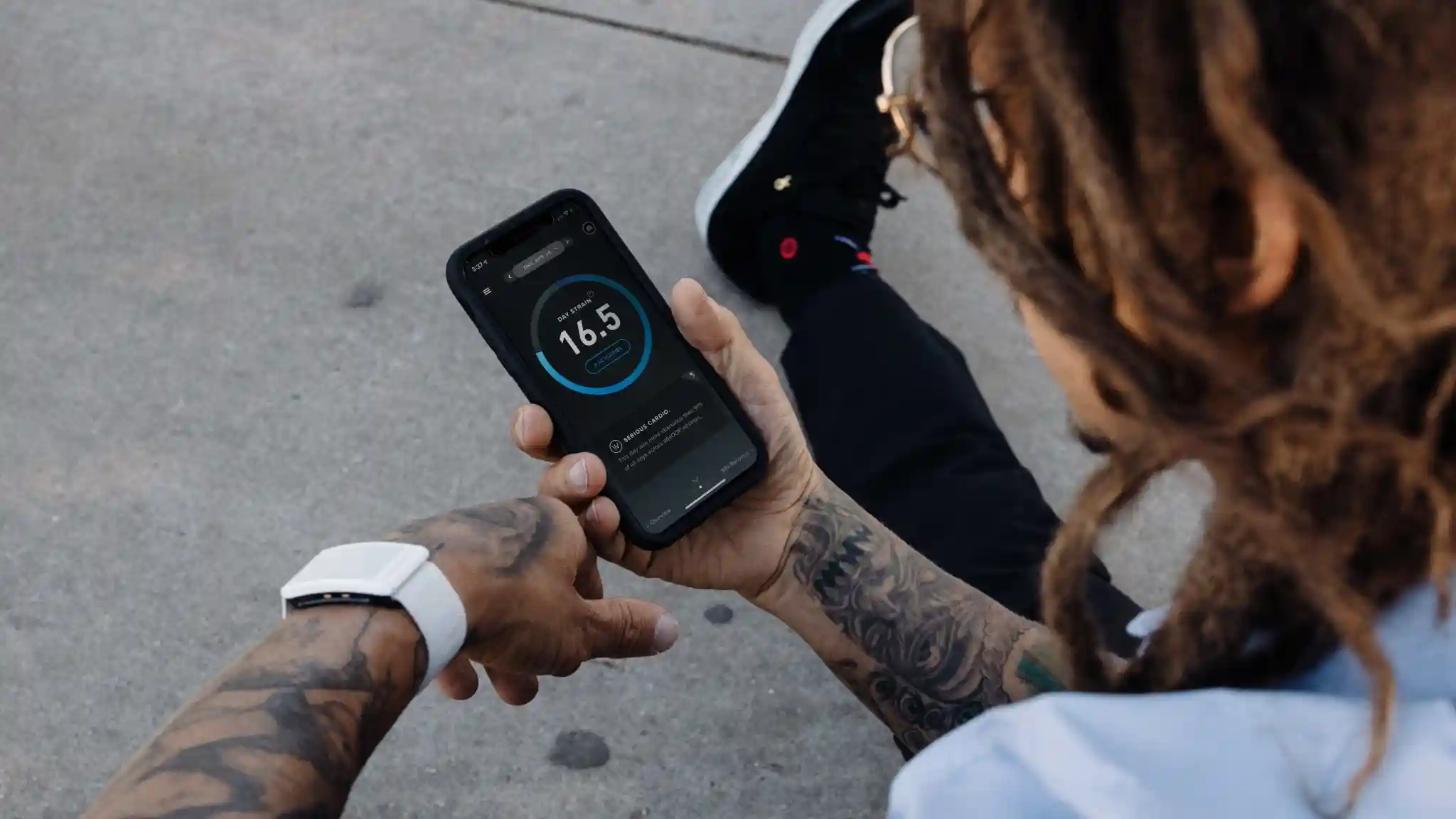
Podcast episode originally published on June 4, 2019
WHOOP Strain measures how much cardiovascular load your body takes on across workouts and the rest of your day. That makes it one of the clearest ways to answer a common training question: how hard did your body actually work?
In this WHOOP Podcast, Dr. Kristen Holmes, Global Head of Human Performance, Principal Scientist at WHOOP, and Emily Capodilupo, Senior Vice President of Research, Algorithms, and Data at WHOOP, explain where the metric came from, why it is individualized, why day strain includes more than exercise, and how to pair Strain with Recovery to train with more intent. Their discussion also shows why a walk to class, a stressful presentation, or poor taper habits can change how prepared you are for the workout or competition that follows.
Note: This article covers WHOOP 3.0. For the latest hardware, see the latest WHOOP device.
For Holmes and Capodilupo’s full breakdown of how WHOOP built Strain, watch Episode 026 of the WHOOP Podcast.
What does WHOOP Strain actually measure?
WHOOP Strain is a 0 to 21 score of cardiovascular load. In practical terms, it reflects how hard your cardiovascular system is working over the course of a workout or a full day.
Capodilupo explains that the original strain model was inspired by Borg’s Rating of Perceived Exertion, a familiar coaching scale that helped athletes and coaches quickly understand what a number meant. WHOOP kept that basic feel, then extended the scale to 21. The important part, though, is not the label. It is the physiology under the label. In this 2019 conversation, Strain is defined around what the wrist can detect well, namely heart rate driven cardiovascular demand.
Around that definition, Holmes and Capodilupo make a useful distinction that still helps people read the score correctly. A session can feel locally hard, especially if it taxes one muscle group, without creating the same cardiovascular response as running, rowing, or a hard conditioning workout. That is why a heavy lower body session and a hard tempo run can feel challenging in different ways, yet produce very different Strain outcomes.
Capodilupo puts that definition plainly:
“So it specifically measures cardiovascular load. So that’s how hard your heart and lungs and nervous system are working in order to take you through this workout. And it does not measure musculoskeletal load.”
That frame is the key to interpreting the score correctly. Strain is not a generic effort badge. It is a cardiovascular demand score. If you are reading this with current product knowledge in mind, it also helps to know that WHOOP later expanded how strain can be contextualized in newer training experiences. For the up to date product explainer, see How Does WHOOP Strain Work?.
What you should take away
- WHOOP Strain was introduced as a 0 to 21 measure of cardiovascular load across workouts and the full day
- The original strain model discussed in this episode centers on heart rate driven demand that the wrist can detect well
- Local muscular fatigue and cardiovascular load are different stress types, so hard strength work and hard conditioning can produce different Strain scores
Why is WHOOP Strain individualized instead of based on steps?
Once you know Strain is a cardiovascular score, the next question is whether the number means the same thing for everyone. It does not. WHOOP individualizes Strain so the score reflects effort relative to your own capacity.
Capodilupo uses a simple example. If two people both finish the day at a 15, that does not mean they produced the same external output. It means each person worked to a similar level within personal fitness, physiology, and current ability. A highly trained endurance athlete and a recreational runner might complete the same route together and land at very different scores, because the same pace asks different things of their bodies.
She makes that point memorable by comparing herself with marathon champion Desiree Linden. If both women ran side by side, Linden would likely record less Strain because the workload takes up a smaller share of her capacity. That is the reason WHOOP focuses on what the work meant to your body, not only what the workout looked like from the outside.
Capodilupo sums up the logic this way:
“If you and I both got, say, a 15, we both worked sort of relatively equally hard within our capacity. But if we’re at different fitness levels, different capabilities, we could have objectively done very different things.”
That same logic is why Holmes and Capodilupo dismiss steps as a central training metric. Steps are easy to count, but they are not sport agnostic, they do not adjust for individual capacity, and they miss whole categories of effort. A swimmer can do a demanding session with zero steps. A cyclist, rower, or squash player can take on plenty of cardiovascular load without moving toward a step goal in a meaningful way. WHOOP Strain is more useful because it translates different activities into a common physiological language. For more common score questions, see Ask Us Anything: WHOOP Strain.
What you should take away
- The same WHOOP Strain score can reflect very different external workloads because the score is individualized to your capacity
- WHOOP Strain is designed to compare physiological effort across people and across sports
- Steps are limited for training decisions because they miss sport context, fitness level, and non step based exercise
What counts toward day strain beyond exercise?
That individualized frame leads directly to one of the most useful parts of the metric: WHOOP measures load across the entire day, not only inside a logged workout. Day strain can rise from exercise, but it can also rise from stress, errands, commuting, standing, childcare, and other repeated movement.
Capodilupo points to familiar examples that many people overlook. Walking the dog, shopping for groceries, lifting bags, moving through a long day on your feet, or gearing up for a stressful presentation can all raise heart rate and add to cumulative load. Each event may feel trivial on its own. Over 16 or 18 waking hours, they stack up.
Capodilupo describes that accumulation clearly:
“If you think about how many of them we might do over the course of 16 hours that we’re awake, 18 hours that we’re awake, it can add up to a lot.”
Holmes explains why this matters in real life. If you have a game, race, hard training session, or mentally demanding event later in the day, day strain changes your starting point. A person who has already built substantial load through work stress and constant movement is not entering the evening session in the same state as someone who stayed physically and mentally quiet through the day.
That is why Holmes talks about intentional low load behaviors before important events. Examples in the episode include napping, massage, mindfulness work, and even choosing the bus instead of walking to class when the goal is to stay fresh. She also shares a team example from Florida State University women’s soccer. During one taper period before the National Collegiate Athletic Association championships, training load came down, but the athletes used freed up time to stay active socially, which kept total strain higher than intended. The following year, the team managed day strain more deliberately and had its best season.
For Holmes and Capodilupo’s full explanation of how work stress, chores, and taper habits shape day strain, watch the full episode of this WHOOP Podcast episode.
What you should take away
- WHOOP day strain includes cardiovascular load from workouts, daily movement, and psychologically stressful moments
- A demanding evening event should be viewed in the context of the full day, not only the workout plan
- Tapering works better when both training load and day strain come down together
- Naps, mindfulness, and low movement choices can help protect performance later in the day
Why do workout strains not add up to your day strain?
Once day strain includes everything you do, people often expect the displayed workout numbers to add up neatly. WHOOP does not work that way because the displayed Strain scale is logarithmic, not linear.
Capodilupo explains that the score had to fit a huge range of human effort onto a bounded 0 to 21 scale. At the low end, the scale needs to capture near complete inactivity. At the high end, it needs to capture extreme events such as the Spectre Series, when a group of Navy SEALs and former Navy SEALs skydived into the ocean, swam three miles, and ran 100 miles to raise money for the SEAL Future Foundation. If WHOOP displayed strain as a simple linear scale, everyday workouts would bunch together at the bottom and stop being useful.
So the underlying load can be accumulated in linear space, while the number people see is presented in scaled space. That makes the score easier to interpret, and it also matches lived experience surprisingly well. Early increases in strain are easier to achieve. Later increases take more and more work.
Capodilupo gives the cleanest example in the episode:
“It actually is easier to go from like a 10-mile run to an 11-mile run than it is to go from like a 1-mile run to a 2-mile run.”
She adds that perceived exertion lines up closely with this scaled presentation, which is one reason the score feels intuitive once people use it for a while. The higher your score gets, the harder it becomes to build more. That is also why two moderate workouts do not simply combine into a huge total. For a broader discussion of how stress accumulates physiologically, see The Science of Strain with Dr. Andy Walshe.
What you should take away
- WHOOP displays Strain on a logarithmic 0 to 21 scale, so later increases are harder to earn than early ones
- Workout Strain values do not add up arithmetically to your day strain
- The displayed scale is designed to keep everyday workouts interpretable while still accommodating extreme endurance and military events
How should you use Strain and Recovery together in training?
After you understand what the score means, the next step is deciding what to do with it. Holmes is explicit here: there is no universal good Strain score. The right amount depends on your Recovery, your training phase, and your intent for the day.
Holmes describes three broad contexts people can use: maintenance, tapering or restorative work, and functional overreaching. If your goal is to keep fitness steady, your strain should live in a range your body can absorb without driving tomorrow’s recovery sharply down. If your goal is to sharpen for an event, lower strain and lower day load can help preserve freshness. If your goal is adaptation, pushing into a harder session can be appropriate, even if next day Recovery dips.
Her guiding question is the core of the section:
“This is my capacity today. What’s my physiological intent? And that kind of dictates what type of strain you want to put on your body.”
Holmes and Capodilupo also caution against simplistic rules. A red Recovery does not automatically mean total rest. Capodilupo argues for active recovery, cross training, or changing the stimulus when appropriate. A runner whose legs are beat up may still tolerate an easy swim, a yoga session, or a moderate bike workout. The point is to support recovery without piling on the same stress again.
The conversation also helps people troubleshoot why Recovery is low. If training has been hard for several days and sleep is solid, lower Recovery may reflect the adaptation cost of training. If training has been moderate but sleep, diet, alcohol, or psychological stress have been poor, the problem may be lifestyle load rather than productive training. Holmes points to a pattern she sees often: people who rely on one style of training, including some CrossFit athletes, can benefit from adding one or two cardiovascular sessions during the week to improve the underlying system that supports recovery and work capacity.
WHOOP later built this logic into How the WHOOP Strain Target Works, which shows how Recovery and accumulated strain can guide a daily target.
To hear Holmes and Capodilupo unpack maintenance, tapering, and functional overreaching in their own words, watch the full episode of this WHOOP Podcast episode.
What you should take away
- The right WHOOP Strain score depends on Recovery, training phase, and the intent of the session
- Functional overreaching can be appropriate when the goal is adaptation and the wider training plan supports it
- Low Recovery does not always require total rest, because active recovery or cross training can be the better choice
- Repeatedly low Recovery can reflect either training adaptation or lifestyle stress, so the surrounding context matters
What did WHOOP 3.0 add with Strain Coach and WHOOP Live?
The earlier sections explain the logic behind the metric. Holmes and Capodilupo finish by showing how WHOOP 3.0 tried to make that logic actionable in real time.
The first feature was Strain Coach. Capodilupo describes it as a move from retrospective feedback toward live guidance. Instead of only reviewing how much strain you accumulated after the fact, the feature was designed to show a maintenance range for the day based on that morning’s Recovery and then show, during a workout, how much strain remained before you entered that range. If your goal was restorative work, you could stay under it. If your goal was overreaching, you could go past it deliberately.
Capodilupo explains the shift this way:
“It turns it into a live, real-time feature that will help you train in the moment, not just understand trends.”
Holmes highlights another benefit. This kind of live feedback gives people without a personal coach access to more specific decision support during training. Instead of guessing whether an extra loop, another interval, or a few more minutes make sense, you can anchor the decision to recovery state and current accumulated load.
The second feature was WHOOP Live, including WHOOP Snap+, which overlaid live heart rate data onto video. Holmes sees the coaching value immediately. If a tennis player starts missing routine shots, a hockey player’s shift quality drops, or running form breaks down while heart rate keeps climbing, the footage can show fatigue developing in real time. Coaches have used video for decades. The added physiological layer helps explain when performance quality begins to slide.
If you want a broader look at how daily targets can shape training frequency, see How Often Should You Work Out? WHOOP Strain Target Can Help.
For the original walkthrough of Strain Coach and WHOOP Live in WHOOP 3.0, watch the full episode of this WHOOP Podcast episode.
What you should take away
- Strain Coach in WHOOP 3.0 was built to turn Recovery and accumulated strain into live training guidance
- A maintenance range gives people a reference point for deciding whether to stay restorative, stay steady, or overreach on purpose
- WHOOP Live added physiological context to video, making it easier to spot fatigue related form or decision breakdowns
The bottom line
- WHOOP Strain is a 0 to 21 score of cardiovascular load across workouts and the full day
- A WHOOP Strain score is individualized, so the same number can represent very different external workloads for two different people
- WHOOP day strain includes work stress, chores, commuting, movement, and other non workout sources of cardiovascular load
- WHOOP day strain is displayed on a logarithmic scale, which is why multiple activity scores do not add up directly
- The right daily Strain target depends on your Recovery, your training phase, and your physiological intent for the day
- Low Recovery does not automatically require complete rest, because active recovery or a different training stimulus may be appropriate
- Strain Coach in WHOOP 3.0 was designed to show a maintenance zone and your progress toward it in real time
- WHOOP Live aimed to connect heart rate data with video so coaches and athletes could see fatigue as performance quality changed
Frequently asked questions about things discussed in this episode
How does WHOOP measure Strain?
WHOOP measures Strain as a cardiovascular load score on a 0 to 21 scale. In the framework discussed in Episode 026 of the WHOOP Podcast, the score rises as heart rate increases and stays elevated across workouts and the rest of the day.
What does WHOOP include in day strain besides workouts?
WHOOP includes non workout cardiovascular load in day strain. Stressful meetings, commuting, chores, errands, standing for long periods, and repeated everyday movement can all contribute to the score.
Why does WHOOP day strain not equal the sum of my activities?
WHOOP day strain is displayed on a logarithmic scale, so the visible numbers do not add arithmetically. The higher the score gets, the harder it becomes to build each additional point.
How does WHOOP handle the same workout for two different people?
WHOOP personalizes Strain to each person’s capacity, so the same workout can produce different scores. A fitter person usually records less Strain for the same external work because the cardiovascular demand takes up a smaller share of available capacity.
What does WHOOP do with Recovery when guiding daily strain?
WHOOP uses Recovery as the context for how much strain your body is prepared to handle that day. In the WHOOP 3.0 framework discussed here, Strain Coach used morning Recovery and strain already accumulated to show a maintenance range and live progress toward it.
What does WHOOP suggest on a low Recovery day?
WHOOP suggests that low Recovery should be interpreted in context rather than through a single rule. Active recovery, cross training, or a lower strain session may fit better than repeating the same hard stimulus, especially when sleep and wider lifestyle stress are part of the picture.
What did WHOOP 3.0 add for live Strain feedback?
WHOOP 3.0 introduced Strain Coach and WHOOP Live to make strain more actionable during training. Those tools were built to show real time progress toward a daily target and to overlay physiological data onto video for coaching review.
On days when training is only part of the load, WHOOP Strain shows how much work your body has already done before the session even starts.