Topics
- Post
- Health & Wellness
- Member Stories
How to build muscle, recover, and train for energy with Don Saladino
Originally published on July 31, 2019
Muscle gain, better recovery, and steady energy come from more than a hard workout. This article breaks down five practical questions on training, food, sleep, and stress, using insights from Don Saladino, the coach known for helping actors prepare for physically demanding roles while keeping performance sustainable.
In Episode 033 of the WHOOP Podcast, Saladino explains how he thinks about lower-body strength, session length, protein intake, recovery routines, and the difference between overtraining and under-resting. If you want a clearer framework for building muscle without feeling run down, this conversation gives you specifics you can apply.
Note: This article covers WHOOP Strap 3.0. For the latest hardware, see WHOOP.
To listen to episode 033 in full, head to the WHOOP Podcast on Spotify.
What should a muscle-building workout actually focus on?
A muscle-building plan should start with big lower-body work, not endless isolation exercises. Saladino argues that if the goal is a stronger, more muscular physique, the fastest route is getting stronger through squat and deadlift patterns while fixing movement issues first.
That is why his sessions begin with screening and prep work. Saladino says he now looks at people joint by joint, uses physical therapists in his facility when needed, and spends the first 5 to 10 minutes of a session targeting the areas a client needs to improve before the main lift starts. From there, the session is built around the real goal, whether that is fat loss, muscle gain, strength, or preparation for a role.
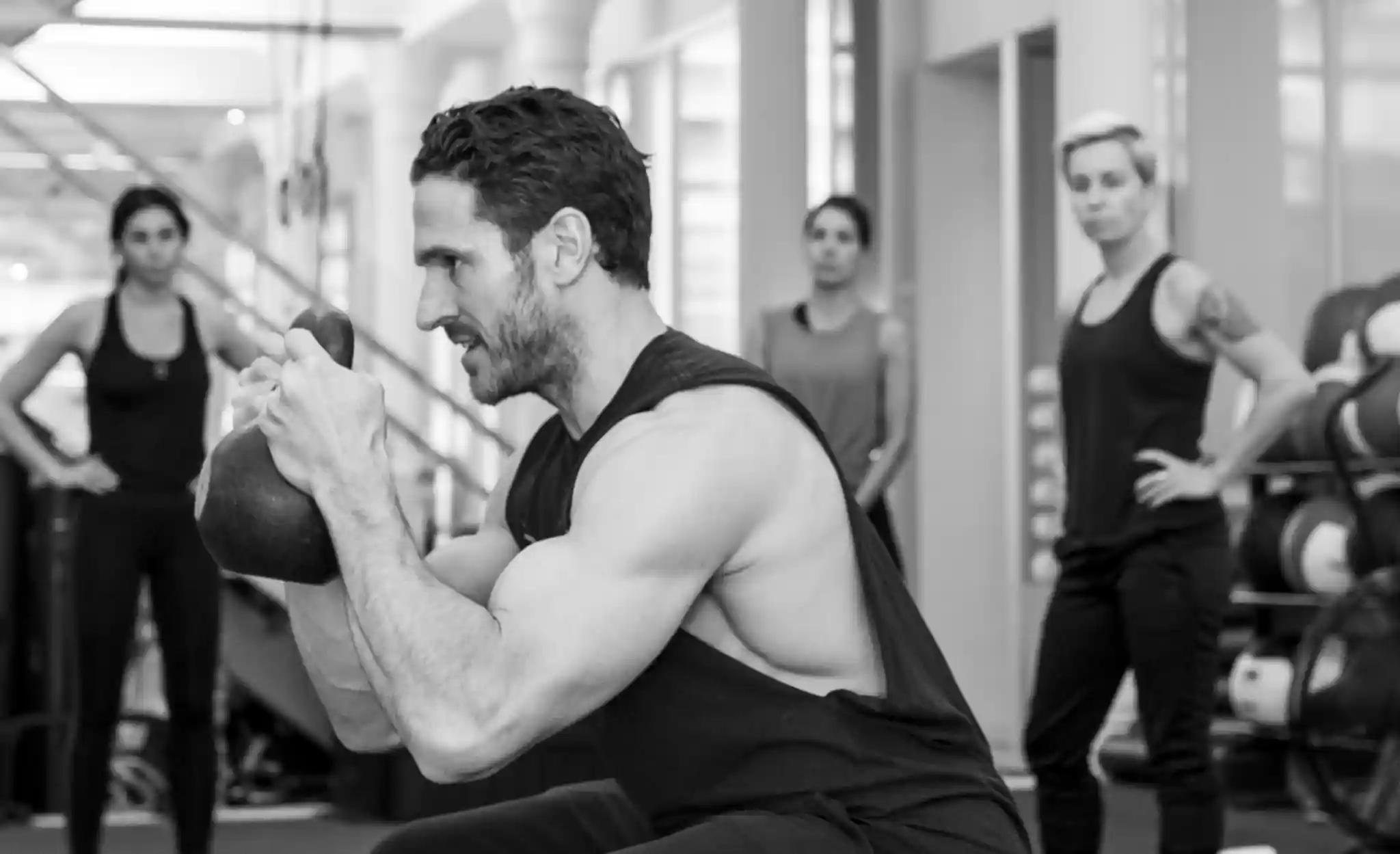
He also pushes back on the idea that back squats are mandatory. A kettlebell front squat, goblet squat, split squat, or deadlift variation can all work if they let someone load the pattern well. WHOOP later expanded on how to quantify lifting work in Episode 219 on Strength Trainer.
In explaining how he helped actors build a superhero look, Saladino put it simply:
"Lower body training is the key. That's probably where people mess up the most. [...] If you want to have that kind of superhero look, your legs better be yoked."
What you should take away
- Lower-body strength work is a core driver of muscle gain and overall physique change.
- Pre-session movement prep can improve how well you tolerate the main workout.
- Squat and deadlift patterns matter more than piling on arm isolation work.
If you want to hear Saladino unpack lower-body training for muscle gain, listen to the full episode on Spotify.
How long should a hard training session last?
Once the training focus is clear, the next question is volume. Saladino's answer is that most people do better with less than they think, especially when work, travel, filming, and family stress are already high.
He says he rarely wants sessions to run far beyond an hour, and often keeps them shorter. Ryan Reynolds is his clearest example. When Reynolds is in a film block and waking up at 4 a.m. to train before long shooting days, Saladino trims the session as much as possible because extra gym time would only add stress, not progress.
This is also where he draws a distinction between overtraining and under-resting. Training is a stressor, but so are flights, sleep loss, deadlines, and life pressure. If those are already elevated, forcing a max effort day can push the body in the wrong direction. That frame lines up closely with the recovery-first thinking discussed in Episode 41 with Jordan Shallow, where parasympathetic recovery days matter as much as hard work.
Saladino makes his cutoff clear in the episode:
"I do not believe in going so far beyond an hour. [...] Your energy level, your focus, specific things will start declining."
What you should take away
- Training stress only makes sense when it fits the rest of your life stress.
- Most people do not need long gym sessions to build strength or muscle.
- A shorter session can be the better choice when sleep, travel, or work strain is high.
If you want to hear Saladino go deeper on training duration and under-resting, listen to the full episode on Spotify.
How should you eat when the goal is muscle without feeling depleted?
Training creates the stimulus, but food decides whether the body can answer it. Saladino's rule for muscle gain is straightforward: get out of a calorie deficit, keep meals consistent, and adjust intake based on the feedback you get.
Instead of guessing from one meal, he likes to look at several days of eating, estimate what someone is already tolerating, and then move calories up or down from there. For protein, he says he often starts around 1 to 1.25 grams per pound of body weight, and may move closer to 1.5 grams for someone trying to add size. He also prefers good food sources, but warns against letting travel perfectionism become its own stressor.
His meal structure is simple enough to repeat. Each meal usually includes protein, a carbohydrate source, and a vegetable, with fat adjusted based on the protein source. For his own Muscle & Fitness cover prep, Saladino said he was still eating close to 500 grams of carbohydrates per day, mostly from sweet potatoes, because eating less made him look flat rather than lean.
That same focus on repeatable meal structure also shows up in Episode 96 with Dan Churchill, which explores how meal timing and food choices affect recovery.
Saladino summed up his baseline nutrition approach this way:
"Every meal pretty much consists of a protein source, a carbohydrate source, and a vegetable."
What you should take away
- Muscle gain usually requires getting out of a calorie deficit, not training harder inside one.
- Protein targets can scale with body weight and training demand.
- A repeatable meal pattern is often more useful than a complicated diet plan.
- Trying to eat perfectly while traveling can create stress that works against recovery.
If you want to hear Saladino unpack how he sets protein and carb intake, listen to the full episode on Spotify.
What habits actually improve sleep and recovery?
Sleep quality improves when the hours before bed are treated as part of training. Saladino says WHOOP helped him realize that his assumed 7 to 9 hours of sleep was often closer to 6 hours and 30 minutes, which pushed him to clean up his routine.
His changes were practical. He started using blue light blocking glasses, put the phone down after getting home, stopped doing late emails, used magnesium, kept the room cool at about 67 degrees, and built in time to calm down instead of going straight from work into bed. He also uses prayer as the last part of his nightly routine and likes recovery tools such as Normatec for 30 minutes before sleep.
What stands out here is how WHOOP Sleep and Recovery changed the conversation from guesswork to visible feedback. Saladino says he can now look at a short night, or a night with drinks, and see the effect in his data the next day. Similar sleep-focused experimentation came up in Episode 44 with Ben Greenfield, especially around blue light and evening routines.
Saladino's main point about recovery was direct:
"I think the number one ingredient for success is sleep. If our sleep is crappy, the best diet, the best training program in the world, it doesn't matter."
What you should take away
- Sleep habits deserve the same planning as workouts and meals.
- WHOOP can reveal the gap between how long you think you sleep and how long you actually sleep.
- A cool room, less late-night screen time, and a longer wind-down can improve recovery.
If you want to hear Saladino go deeper on sleep routines and blue light exposure, listen to the full episode on Spotify.
What is the real goal of training for most people?
After muscle, session length, food, and sleep, Saladino lands on a bigger point. For most people, the real goal is not a magazine-cover physique. It is enough energy to feel good all day and enough consistency to keep going.
He is blunt about how many people get lost chasing someone else's aesthetic. Social media can make extreme physiques look like the standard, but Saladino says most people need a coach or program that helps them build momentum with manageable work. Sometimes that means 15-minute sessions, walking, swimming, pushups, stairs, or just breaking a sweat every day. The standard is not punishment. The standard is repeatability.
That long-view coaching mindset echoes Episode 11 with Joe Holder, where the hours outside the workout matter most. Saladino's version is centered on all-day energy. If sleep, training, and food are in a good place, he believes everything else gets easier to manage.
He framed that goal in the opening moments of the episode:
"99% of the people on this planet, they're not Rocky. They'll never be Rocky. [...] I think the ultimate message is energy."
What you should take away
- The best training plan is the one you can repeat without burning out.
- Short sessions can still move body composition, recovery, and energy in the right direction.
- Energy across the full day is a better benchmark for most people than chasing an extreme physique.
The bottom line
- Lower-body strength work is one of Saladino's main levers for building muscle and changing body composition.
- Sessions that stay around an hour, or less, often fit recovery better than longer workouts.
- Under-resting can look like overtraining when life stress, travel, and short sleep pile up.
- Muscle gain usually requires getting out of a calorie deficit and eating enough protein, carbohydrate, and whole foods to support training.
- WHOOP helped Saladino spot that his real sleep time was lower than he assumed, which led to changes in his evening routine.
- Alcohol can hurt recovery through sleep disruption and hormonal stress, even when calories are not the main issue.
- Most people benefit more from consistent daily movement and stable energy than from chasing a movie-role physique.
Frequently asked questions about things discussed in this episode
How does WHOOP help you spot when training stress is too high?
WHOOP helps you spot training stress by showing daily Sleep, Recovery, and Strain together, so a hard workout can be viewed in the context of short sleep, travel, or other stressors.
How does WHOOP help with sleep routines?
WHOOP helps with sleep routines by showing how much sleep you actually got and how changes in behavior affect next-day Recovery. Saladino used that feedback to tighten his evening habits.
What does WHOOP show after alcohol?
WHOOP shows how alcohol can lower next-day Recovery by disrupting sleep. Saladino specifically used Recovery data to connect drinks at night with worse readiness the next morning.
How does WHOOP support shorter training sessions?
WHOOP supports shorter training sessions by helping you compare how much strain a session created with how well you recovered from it. That makes it easier to see when more volume stops helping.
What does WHOOP do for people who travel often?
WHOOP helps frequent travelers see how flights, schedule changes, and late nights affect sleep and Recovery. That kind of feedback can guide whether the next session should stay hard or shift toward recovery.
For training built around muscle, sleep, and all-day energy, WHOOP gives you a clearer read on whether your body is ready to push or needs a quieter day.