Topics
- Article
- Habit Guidance
- Behavior Impact
Behavior Change Science: Habit Loops, Cues, Rewards
Making adjustments to your daily routines can be difficult, especially for habits that have been in place for months or years. The brain forms habit loops based on repeated behaviors, which can be challenging to break. This guide breaks down key insights from behavior change experts to help you reevaluate your routine and develop beneficial habits to achieve your goals.
The stages of behavior change
Behavior Change is a process, not a single event. Research shows that people move through distinct stages when modifying a habit. Understanding these stages can help you identify where you are in your journey and what to focus on next.
- Precontemplation: You are not yet considering change and may not see your behavior as a problem.
- Contemplation: You are aware that a problem exists and are thinking about overcoming it, but you have not yet made a commitment to action.
- Preparation: You are intending to take action in the immediate future and may begin taking small steps toward the behavior change.
- Action: You are actively modifying your behavior, experiences, or environment in order to overcome your problem.
- Maintenance: You have made the change and are now working to prevent relapse and consolidate the gains you have made.
Understanding habit loops
According to Dr. Jud Brewer, renowned neuroscientist and habit researcher, "If we don't know how our minds work, there's no way that we're going to be able to work with our minds. So if we can understand how our minds work, then we have a tool to be able to work with our minds." In order to be able to break unhealthy habits and create more optimal patterns of behavior, it's essential to first understand habit loops.
A habit loop is a concept designed to help explain how the brain forms habits and how they affect behavior. There are three main components: the cue (stimulus that triggers automatic behavior), the behavior itself, and the reward (perceived benefit to the brain). When these three components occur repeatedly over time, the brain forms a neural pathway that connects them.
A simple example of the habit loop in action is brushing your teeth in the morning. You might always perform this action after you finish eating breakfast, before you leave for work. Finishing breakfast is the cue, while brushing your teeth is the behavior. The reward could be fresh breath or the clean feeling you get after brushing. With repetition, this behavior becomes a standard part of your routine, taking place at the same time each day — all thanks to the habit loop.
Habit loops can also be created for unhealthy or unhelpful behaviors. As an example, when you're feeling overwhelmed or stressed, you may have a tendency to bottle up your frustrations. Here, the cue is feeling out of control, so the behavior is shutting down. Instead, turn to mental health and mindfulness exercises to help, like therapy sessions, journaling or meditating.
Dr. Brewer recommends maintaining a growth mindset and embracing curiosity about why certain habits have been formed, and what perceived reward they offer the brain. If after examining the habit loop a behavior is found to be unhelpful, Dr. Brewer suggests "giving the brain something better. Something better could simply be stepping out of an old habit loop." Alternatively, it could be coming up with a more optimal behavior.
With this approach, Dr. Brewer states that the new habit "becomes a habit not because we think we should do it because it will be good for us, but because it feels good when we do it and we can build that positive reinforcement based on our own direct experiences."
Identifying triggers and cues
Before you can build a better habit loop or simply discontinue an unhelpful one, you have to be able to identify the different components of a loop in your own life. A good starting point is at the first step in the loop — the cue or trigger. Experts have identified several types of stimuli that often serve as cues for habit loops. These triggers include:
- Time — Many habits are linked to specific times of day, as evidenced by the tooth brushing example. It's common for people to associate specific behaviors with common benchmarks of time, such as morning, afternoon, and evening or around certain events such as the three daily meals or the commute to and from work.
- Emotional triggers — Specific emotional states are also often the foundation of various habit loops. The example of eating while bored falls under this category. The emotional state of boredom triggers the behavior of eating. If you often perform specific behaviors when you experience certain feelings, you're likely to form a habit loop around them and repeat that behavior when you experience the same emotion in the future.
- Social cues — The actions and behavioral patterns of other people can also be highly influential in your own habit loops. If a loved one who you spend a lot of time with is making unhealthy choices consistently, you may be more likely to fall into the same pattern of behavior. On the flip side, if everyone in your close friend group decides to start exercising and trying out healthy habits, you may feel inclined to join in and form positive habit loops. The actions of others online through social media can also have a significant impact on habit formation and behaviors.
- Location — Specific locations and environments can act as triggers for habit loops. Your brain may associate the refrigerator with delicious snacks, and so every time you walk past it you might open it and look for something to eat. If you had a negative experience at a gym, you may feel uncomfortable in fitness environments and avoid exercise in order to avoid the associated discomfort.
If your goal is to change an unhelpful behavior, focus on trying to understand why this behavior keeps occurring without judgment. Dr. Brewer emphasizes the importance of combining kindness with self-awareness in recognizing triggers.
Brewer explained on the WHOOP Podcast, "Our brains learn from sweetness. So if we're bitter on ourselves, if we're constantly judging ourselves, we're actually closing ourselves down from learning. The other piece that's really helpful is learning to recognize those self-judgmental habit loops... and see how unrewarding they are, and then bring in some kindness."
Brewer emphasizes that negative judgments about one's actions and self-deprecation feed into a fixed mindset, which is the opposite of the growth mindset that is most optimal for making successful behavioral changes. These judgments can become habit loops of their own, which in turn reinforce unhelpful behaviors that are part of the undesirable habit loops that are the subject of the judgments.
To combat this negative cycle, Brewer advises pairing awareness of triggers with kindness. Instead of judging yourself for your habits, try out a more positive outlook that's focused on understanding why you made certain choices and fell into particular habits and that leaves room for future improvement. This outlook leaves plenty of room for growth and positive behavioral change.
Creating a supportive environment
Environmental factors can play a significant role in shaping behavior. Location is one of the four most common triggers for habit loops, highlighting the impact space and environmental conditions can have on the formation of habits.
Environmental influence on behavior was exemplified by cognitive scientist Dr. Maya Shankar with the so-called 'Fresh Start Effect' on the WHOOP Podcast. The Fresh Start Effect refers to the phenomenon where individuals experience increased motivation to make behavioral changes when they enter into what is perceived as a new time period or location.
Dr. Shankar gives the example of moving to a new house or apartment, after which "your commute to work is going to change, where you get your coffee in the morning is going to change, your friendship group might change. So it's fertile soil for introducing other changes because you don't have these built-in routines and habits that you're really stuck to, which can make behavior change hard."
When you enter into a completely fresh environment, there is plenty of room for new, positive habits to be formed because you have left all of your typical routines behind.
Setting up an environment conducive to behavioral change doesn't have to involve moving to a new city or apartment complex. There are also changes that can be made to your existing environment to facilitate improvements in habit loops. Shankar explains that self-control is often pointed out as a roadblock to achieving goals and sticking to healthy habits.
She suggests, "Rather than seeing self-control as this limited resource that we're tapping into, and then finally we've exhausted it, we should just set up our environments so that they don't require self-control — so you don't actually have to exert self-control in order to reach your goals."
Shankar describes a situation where the lengthy process of searching for gym gear in the morning gets in the way of actually going to the gym. To avoid this issue altogether, you could "pack your bag the night before and leave it by the door so there's no decision-making to be made in the morning. And you don't need to use any cognitive effort to set yourself up for success."
Taking the time to plan your environment to reduce or eliminate obstacles to achieving desired goals and habits is an excellent solution for getting your habit loops into shape.
Setting realistic goals
Behavioral change can be overwhelming. The prospect of changing the everyday habits that you've grown accustomed to can be very daunting, and can easily discourage you from trying to make any changes at all. It's important to set realistic and achievable goals so that you don't end up feeling like you should give up when you don't see major changes right away.
Shankar recommends breaking large goals down into more manageable steps. She states, "We want to parse the large goal into micro milestones — easier steps that make it more likely you'll go from point A to point B. You need to make concrete plans that are implemented day to day, because long-term goal pursuit is just the execution of that goal on any given day."
A great way to make progress towards bigger goals is to come up with simpler objectives in the short-term that will get you closer to your long-term goal. Over time, as you start to see small improvements, you can adjust your short-term goals to get you closer to your large, long-term goals.
Building a support system
Research consistently shows that changes in health behavior are positively associated with perceived social support. Individuals who have a strong support system are more likely to implement and maintain healthy lifestyle adjustments. Friends and loved ones help you stay on track and maintain sustainable habit loops.
Leveraging rewards and reinforcement
Reward is the third component in the habit loop theory. This is the benefit that the brain comes to expect from a particular behavior. With a desirable habit such as exercising regularly, the benefit could be the feeling of endorphins being released at the end of a workout or improvements in strength and fitness level that can be seen with consistent workouts.
The brain also perceives reward from undesirable habits. For example, scrolling on social media when you are sad provides a distraction from your emotional state. This brief distraction is a reward to the brain, reinforcing the pattern of social media use whenever you feel down in the future.
The brain's tendency to link rewards with behaviors through the formation of habit loops can be used to your advantage. Brewer explains that "there's an error term called positive or negative prediction error, which basically means if we pay attention to something, and it's more rewarding than our brain had thought... we get a positive prediction error, we're going to do it more." In contrast, if a behavior is found to be less rewarding than we originally thought, it reflects a negative prediction error and we tend to do it less.
Awareness is key to being able to identify these prediction errors. Evaluating your habit loops with an open mind can help you determine which ones have rewards that are less than optimal, such as excessive social media scrolling or procrastination. It can also help you see which habits or potential behaviors have rewards that are more beneficial than you realized. Once you're able to see the positive rewards that a behavior can provide, you're more likely to stick with it and form a positive habit loop as part of a successful behavioral change.
Measure your progress with WHOOP
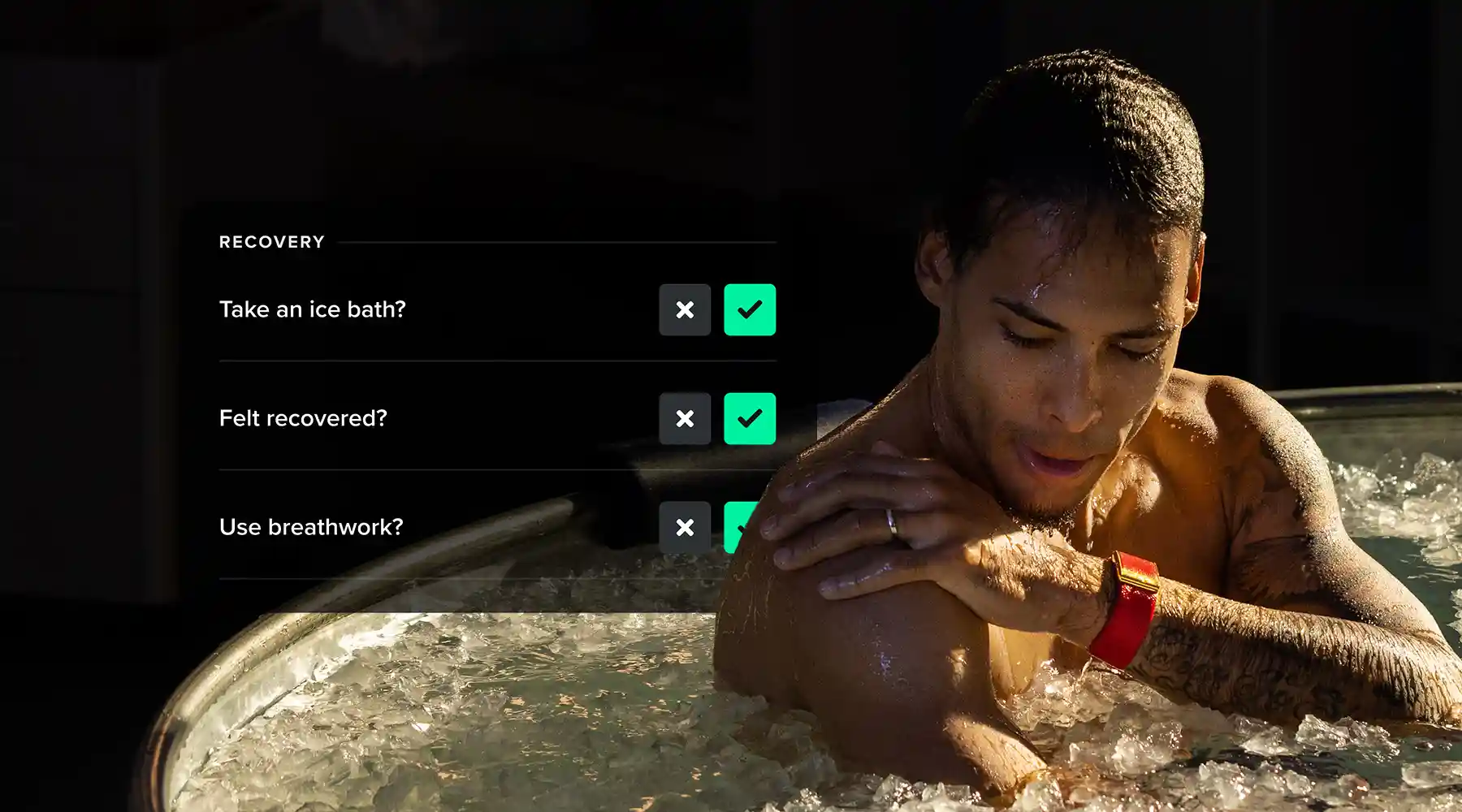
With the WHOOP Journal, you can record your behavioral change efforts. WHOOP Journal allows you to track over 300 different behaviors from categories, such as lifestyle, nutrition, recovery, and mental health. You can see how changes in your behavior and habit loops influence your WHOOP data over time, and determine what adjustments should be made in the future to continue seeing improvements.
Change is a dynamic process of awareness, action, and reinforcement. By understanding the stages of change and the mechanics of your own habit loops, you can move from intention to sustainable action. WHOOP provides the data and insights you need to make better choices, measure what works, and turn positive behaviors into lasting improvements.
Frequently asked questions about behavior change
What is the difference between a behavior and a habit?
A behavior is any single action you take. A habit is a behavior that has been repeated enough times to become automatic. While all habits are behaviors, not all behaviors are habits. The goal of behavior change is often to turn intentional, positive behaviors into effortless, healthy habits.
How long does it take to form a new habit?
There is no magic number. The time it takes for a new behavior to become automatic varies widely depending on the person, the behavior, and the circumstances. The key is not to focus on a specific timeline, but on consistency. Consistent repetition is what builds the neural pathways that form a habit.
What is the most important first step to changing a behavior?
The most important first step is awareness. Before you can change a behavior, you must recognize the habit loop that drives it — the cue that triggers it, the routine itself, and the reward your brain gets from it. Without this awareness, you are simply relying on willpower, which is often not enough for lasting change."