Topics
- Article
- Strain
- Metrics
WHOOP Strain Explained: How Your Effort Is Measured

Strain is one of the fundamental metrics on WHOOP. It quantifies the workload your body takes on throughout the day, from intense training sessions to the cumulative stress of daily life. Understanding how Strain works — and how to interpret your score — gives you the insight to train smarter, recover better, and make decisions that align with your body.
Below, we’ll explain what Strain is, how it’s calculated, what the numbers mean, and how to use this metric alongside Recovery to unlock your potential.
What is WHOOP Strain?
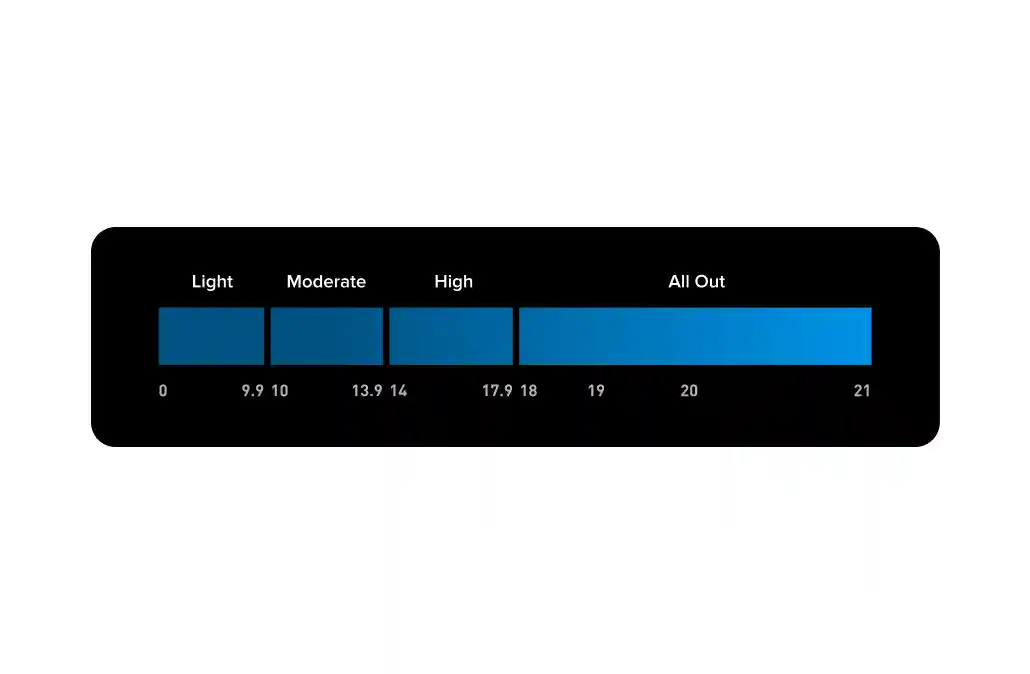
WHOOP Strain is a measure of cardiovascular and muscular exertion that quantifies the amount of physical and mental stress you’re putting on your body. We track your strain on a 0-21 scale, both for your entire day and for specific workouts and activities. Inspired by Borg’s Rating of Perceived Exertion, strain numbers can be loosely broken down as follows:
Understanding your Strain score
WHOOP measures your strain on a 0-21 scale, providing a clear picture of the exertion your body has undergone. To make this number more actionable, it can be broken down into four key zones:
- Light (0-9): Minimal cardiovascular stress, ideal for active recovery and allowing your body to repair.
- Moderate (10-13): Moderate stress that maintains your fitness without requiring extensive recovery, similar to Zone 2 training intensity.
- High (14-17): Significant cardiovascular stress that, when balanced with proper Recovery, stimulates fitness gains.
- All out (18-21): Significant overreaching that requires one or more days of active recovery.
How WHOOP calculates Strain
WHOOP measures Strain based on cardiovascular load and muscular load. Cardiovascular load tracks your heart rate — the higher it gets and the longer it stays elevated, the more Strain you accumulate. Muscular load captures the work your muscles do, giving you a complete picture of your training load — whether you’re lifting, doing HIIT, or flowing through yoga.
Cardiovascular load is automatically calculated using the advanced sensors in your WHOOP device. The higher your heart rate for a longer duration, the higher your strain will be.
Muscular load is factored into your Strain score in three ways:
- Automatic estimation for strength activities: For activities like weightlifting, functional fitness, HIIT, and powerlifting, WHOOP automatically estimates muscular strain based on activity type and duration. These estimates were derived from millions of Strength Trainer sessions. No logging required — just start your activity and lift. Because this estimate is based on duration, linking your exercises gives WHOOP more to work with if intensity matters.
- Link exercises after your workout: Want more accurate measurement? After your activity ends, you can link the exercises you performed. WHOOP uses your selected movements to estimate a more precise muscular load — accounting for which muscle groups were involved and the typical demands of each exercise.
- Log in real-time with Strength Trainer: For the most precise tracking, log your sets, reps, and weights during your workout using Strength Trainer. WHOOP measures each rep’s speed and intensity to give you the most accurate muscular load calculation.
Yoga, Pilates, and barre are calculated automatically using research from WHOOP Labs — no logging needed.
Most wearables only track cardiovascular load, which works well for running or cycling but misses the full picture for low-impact activities like yoga and Pilates that challenge your muscles differently than cardio.
The metric muscular load includes both volume and intensity components.
- Volume incorporates effective mass, accounting for your body mass and the parts of your body that are moving. A full-body exercise like a squat will have more muscular load than a bench press.
- Intensity quantifies your effort, including movement speed and proximity to failure.
WHOOP then calculates the cardiovascular and muscular load to give you one complete Strain score. Regular daily activities like work, commuting, running errands, and parenting may all cause strain. So can stress, anxiety, excitement, or feeling nervous–even being a sports fan is strenuous.
WHOOP calculates your strain for the entire day, and for specific periods of exercise or activity.
Activity Strain vs. Day Strain
WHOOP automatically detects your workouts and assigns a Strain score. Your total Day Strain includes cardiovascular load outside of exercise — a presentation at work or a busy afternoon with kids can raise your Strain even on rest days.
If you have multiple workouts in a day, the strain of your activities does not add up to your total Day Strain. The WHOOP algorithm is logarithmic, meaning the higher your Strain gets, the harder it becomes to build more. It is much easier to go from 0 to 10 than from 10 to 20.
Running a marathon might lift your Day Strain to 20.4, but running a second one that day could only increase it to 20.6.
What is a "normal" amount of Strain?
The average Strain for all WHOOP members is 11.0 per day. The number tends to decrease with age, as shown below:
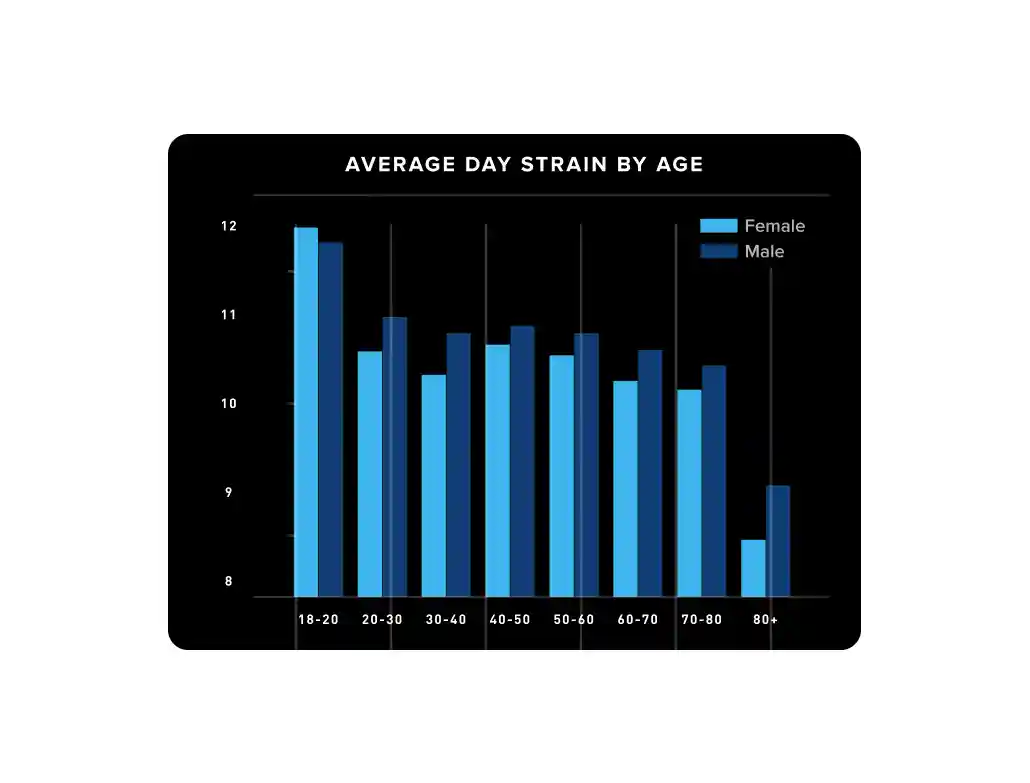
The average daily Strain for WHOOP members is about 11.0. It decreases with age.
More intense aerobic exercise leads to higher Strain. The average Strain for 1 hour of running is roughly 12.0, while an hour of walking is about 6.5. The average Strain for 1 hour of functional fitness is 10.1.
Strain is highly individualized
Strain is calculated from your personal heart rate metrics and accounts for your individual fitness level. Two people who complete the same activity may have very different Strain scores. A 90-minute hike that registers a 10 or 11 for the average person might be just a 5 or 6 for a highly conditioned athlete.
As your fitness improves, you'll see lower Strain scores for the same activity.
The relationship between Strain and Recovery
The higher your Recovery, the more Strain your body is ready to take on.
Strain accumulates faster on low Recovery days because your body is not as prepared to handle it. A workout that usually gives you a 9.5 might be a 10.5 when you're in the red.
Strain Target suggests an optimal amount to take on each day based on your Recovery. It's a recommended level intended to let you maintain fitness and still adequately recover the following day.
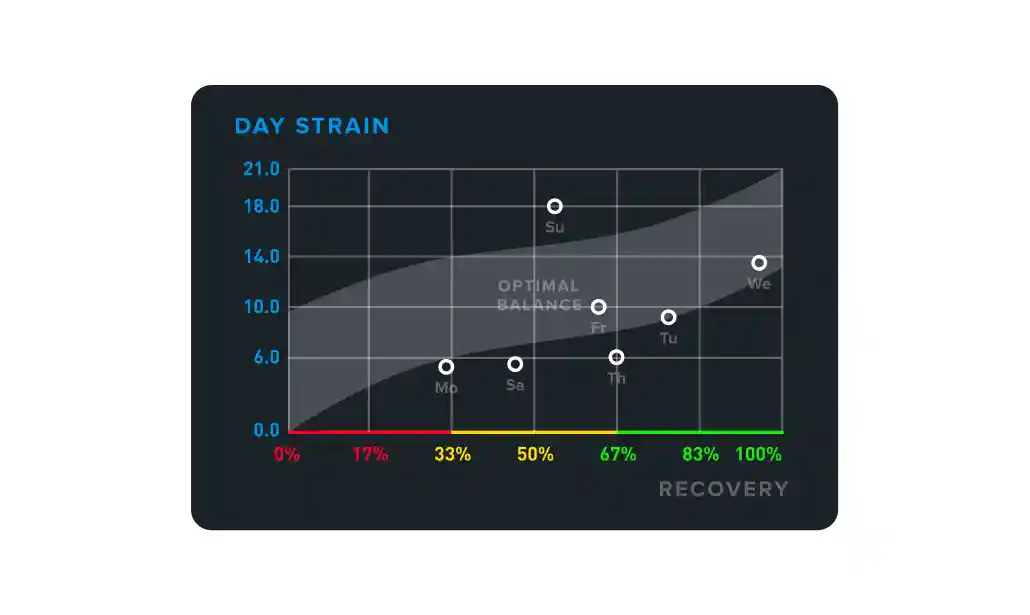
Balance Strain and Recovery to unlock your potential
Understanding Strain is the first step. Applying it is how you make progress. Balance your daily Strain with your body's preparedness through autoregulation, measured by your daily Recovery.
On high Recovery days, your body is primed to take on more Strain to build fitness. On low-Recovery days, prioritizing rest allows your body to recharge and adapt.
By using Strain and Recovery together, you can train smarter, reduce your risk of overreaching, and ensure your effort translates into meaningful results. Ready to see how your daily effort impacts your goals? Join WHOOP and start balancing your Strain and Recovery.
Frequently asked questions about WHOOP Strain
Why did my Strain score increase for the same workout?
WHOOP now automatically includes muscular strain for strength activities like weightlifting, functional fitness, and HIIT. Previously, Strain for these activities only reflected cardiovascular effort. Now it captures both cardio and muscular strain — so if you’re seeing higher Strain for the same workouts, that’s expected. Your body was always doing that work; now WHOOP accounts for it.
If you want even more accurate measurements, you can link your exercises after the workout or log them in real-time with Strength Trainer.
Is a high Strain score good or bad?
A high Strain score is not inherently good or bad—it measures how much work your body has done. The value depends on your Recovery.
High Strain on a well-recovered day can lead to fitness gains. The same high Strain on a low-Recovery day may lead to overtraining.
Why is my Strain score different from my friend's for the same workout?
Strain is a personalized metric based on your individual cardiovascular fitness and maximum heart rate. If you are more conditioned than your friend, your heart will work less to perform the same activity, resulting in a lower Strain score. As your fitness improves, you will notice your Strain for similar workouts decreases.
Can mental stress cause a high Day Strain?
Yes. Strain measures the total load on your cardiovascular system. Any stimulus that elevates your heart rate for a sustained period, including psychological stress from a demanding job, public speaking, or general anxiety, will contribute to your overall Day Strain, even without physical activity.
Does a high Strain score guarantee fitness gains?
No. Fitness gains are the result of a consistent cycle of stress and recovery. A high Strain score represents stress, but without adequate Recovery, your body cannot adapt and grow stronger. Balancing periods of high Strain with days of lower Strain and sufficient sleep is the key to long-term improvement.
Balancing high Strain with lower Strain days and sufficient sleep is key to long-term improvement.