Topics
- Post
- CrossFit
- Member Stories
How young CrossFit athletes train, recover, and build confidence
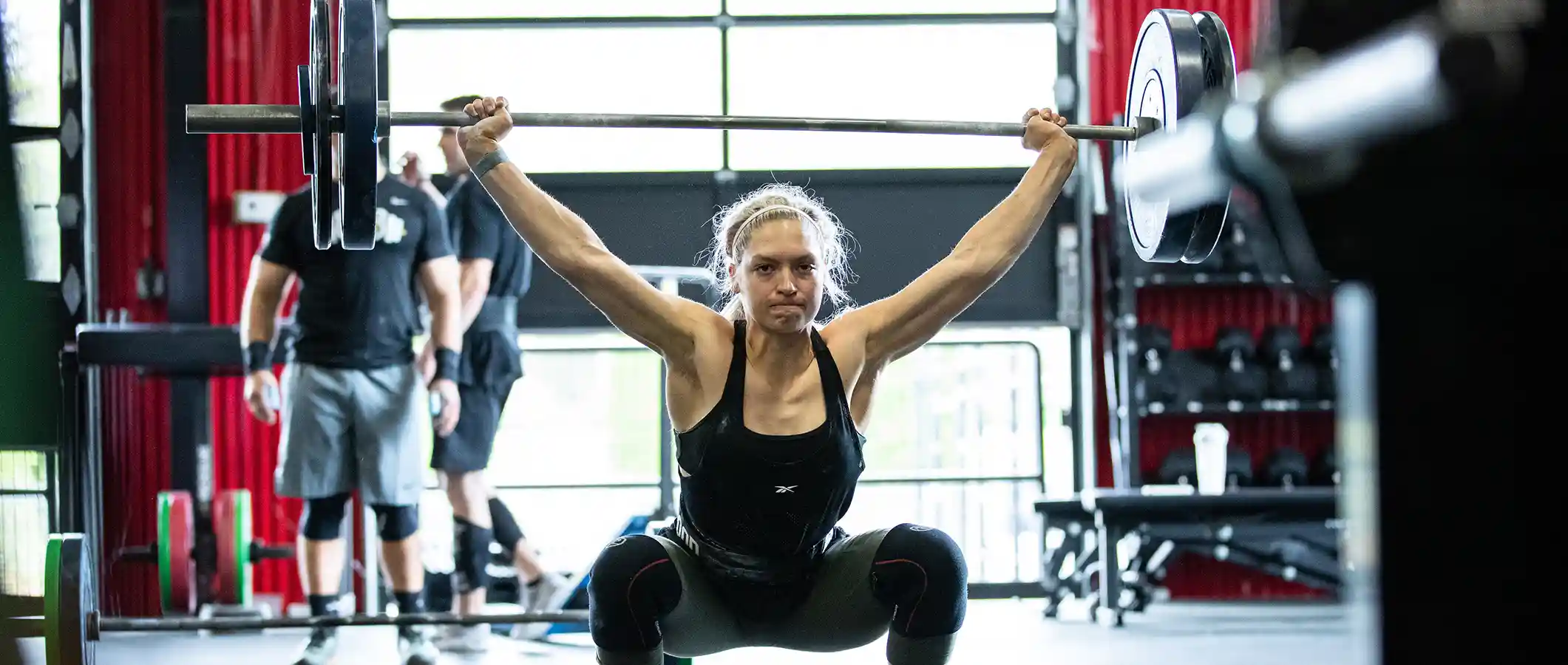
Originally published on May 11, 2021
CrossFit training at a young age demands two things at once: elite work capacity and the judgment to know which sessions actually bury recovery. Haley Adams joined Episode 123 of the WHOOP Podcast after winning the CrossFit teen division in 2018 and finishing sixth and fourth in her first two adult CrossFit Games appearances. In her conversation with Mike Lombardi, Adams explains how she made the jump from gymnastics to elite CrossFit, how she adjusts training when WHOOP Recovery is mediocre, what she was doing to raise her strength ceiling, which sleep and fueling habits helped her stay ready, and why being visible in the sport comes with responsibility.
To listen to episode 123 in full, head to the WHOOP Podcast on Spotify.
How do young athletes make the jump from teen CrossFit to the elite field?
The jump from winning the teen division to surviving the elite field is less about talent and more about absorbing a very different workload. Adams said the teen division still demanded full effort, but the elite level introduced more volume, more intensity, and a much smaller margin for error.
That shift showed up quickly in her results. She won the CrossFit teen division in 2018, then finished sixth and fourth in her first two adult CrossFit Games appearances. Adams traced some of that rise back to her athletic background. Before CrossFit, she had years of gymnastics, plus stints in softball, soccer, cross-country, and swimming. She first noticed CrossFit through the glass windows of a gym next to her gymnastics facility, then slowly moved from doing CrossFit a few days a week to going all in after her freshman swim season.
Her early inspiration also came from watching athletes she later competed against. Adams remembered seeing Annie Thorisdottir on television before she understood much about the sport. That detail matters because the athletes who shape a young competitor's expectations often become the same athletes who reset those expectations later. Adams eventually reached a point where she lined up next to people she had watched on ESPN, then had to decide whether she belonged there. Readers who want more background on one of the athletes she mentioned can revisit Episode 183 of the WHOOP Podcast with Annie Thorisdottir.
Adams described the jump this way:
"The intensity and the volume of the elite level is totally different. Just having to sell your soul in every single workout just to maybe get in the middle of the pack was something that was totally different for me, and I had to learn to really run my own race."
What you should take away
- The move from teen CrossFit to elite CrossFit changes the total workload, not only the level of competition.
- A broad athletic background can help a young athlete adapt to mixed-modal training demands.
- Learning to pace your own effort becomes more important when every workout has higher volume and higher intensity.
If you want to hear Adams unpack the jump from the teen division to elite competition, listen to the full episode on Spotify.
How does Haley Adams adjust training when Recovery is mediocre but the work still has to get done?
Adams does not treat every hard session as equal. She learned that certain workout formats hit her next-day recovery harder than others, which gave her a more useful way to modify training than simply deciding she felt tired.
As her training load increased, Adams started noticing a pattern in WHOOP data. High-intensity metcons with a heavier barbell in the 10 to 15 minute range tended to make her feel sluggish and drag down next-day Recovery. Longer intervals, especially running, were easier for her to absorb. That gave her a practical rule for days when Recovery was middling. If she woke up feeling smashed, she could swap toward cardio or lighter accessory work instead of forcing the exact same mixed session.
She also made an important distinction that many athletes miss. A 55 percent Recovery did not automatically mean she skipped training. It meant she changed the shape of the day. That could include more cardio, a lighter pump session, more food, and more actual rest between sessions. Instead of filling the gaps with errands or extra activity, she tried to lie down and reduce non-training stress.
That same mindset shows up clearly in later competition data. In CrossFit Games heart rate data from Haley Adams and Team Mayhem Freedom, you can see how multi-day event strain and next-day readiness can move sharply in both directions.
Adams gave the most specific version of this pattern when she said:
"Metcons with really high intensity but still like that 10 to 15 minute time frame with a heavier barbell really seem to catch up to me and make me feel kind of sluggish and affect my recovery score the next day. Usually longer intervals and stuff like running seem to help in some way."
What you should take away
- Mixed-modal athletes can respond very differently to short, heavy metcons versus longer aerobic intervals.
- A mediocre Recovery score can be a cue to change workout type, not a cue to stop moving altogether.
- Rest between sessions includes limiting non-training stress, not only finishing the workout itself.
If you want to hear Adams go deeper on which workouts hit her recovery the hardest, listen to the full episode on Spotify.
What was Haley Adams trying to improve after a fourth-place CrossFit Games finish?
Once Adams had proof that she belonged in the elite field, the next step was clearer. She needed to raise her top-end strength without losing the engine that got her there.
That goal shaped how she talked about training at CrossFit Mayhem in Cookeville, Tennessee. Adams originally moved there thinking she might compete on a team after changes in the CrossFit structure made the individual route feel less certain. Instead, the move became the best decision she could have made for her individual career. She ended up training daily around Rich Froning, whom she described as an older brother, and absorbed a culture where the hard days were shared and the standard stayed high.
The confidence side of this mattered as much as the physical side. Adams remembered the first event of the 2019 CrossFit Games, when she looked around and realized she was ahead of athletes she had admired. That became the moment when belonging stopped being theoretical. Later in the episode, she also shared quarterfinal placements of fifth, third, first, twenty-eighth, and then a much lower finish on a heavy squat event, a reminder that strength ceiling was still the obvious place to keep pushing.
The competition setting she was chasing had already been on display in Episode 34 of the WHOOP Podcast from the 2019 Reebok CrossFit Games, where athletes and coaches talked through the demands of performing on the sport's biggest stage.
Adams summed up her main training objective in one sentence:
"We are just trying to overall increase my top-end strength. That is something that has been building for a while."
What you should take away
- A fourth-place finish can clarify the next training block by showing exactly where the ceiling still is.
- Top-end strength was the clearest development target Adams named after establishing herself as an elite athlete.
- Confidence often becomes more durable after a competition moment confirms that performance belongs with the field.
If you want to hear Adams unpack strength work, quarterfinals, and what changed in her confidence, listen to the full episode on Spotify.
Which sleep and fueling habits helped Haley Adams recover from hard training?
Adams treated sleep like a training input, then built her evenings around what made sleep more likely. Her baseline target was simple: at least eight and a half hours, and closer to nine and a half when possible.
From there, the details became personal. Adams preferred a dark, cold room with two fans running. She said she had trouble falling asleep during hard training periods even when total food intake stayed high, so she used a later dinner and extra snacks to stay full before bed. Rice cakes, oatmeal, and higher-fat foods were regular late-night options. She also told Lombardi that CBD and sauna sessions near the end of the day seemed to help her sleep and next-day Recovery.
The useful point here is not that everyone should copy her exact bedtime routine. It is that she had already started connecting behaviors in the WHOOP Journal with how she slept and recovered. She also acknowledged that late eating affects people differently, which kept the conversation grounded in individual response rather than generic advice. In a later competition setting, Adams returned to the same themes in Haley Adams answers 13 questions about Wodapalooza, where she again pointed to sleep and quality food as recovery priorities.
Adams gave the clearest numerical picture of her sleep target here:
"I would say my minimum is usually eight and a half. High end would be nine and a half."
What you should take away
- Adams built recovery around a repeatable sleep window of roughly 8.5 to 9.5 hours.
- A colder sleep environment and consistent wind-down routine were part of her sleep setup during heavy training.
- Late-night fueling was useful for Adams because going to bed hungry made her wake up through the night.
- WHOOP Journal entries can help connect bedtime habits with next-day Recovery on an individual basis.
If you want to hear Adams go deeper on sleep, sauna timing, and late-night fueling, listen to the full episode on Spotify.
Why does Haley Adams care so much about being a role model in CrossFit?
For Adams, performance and visibility were connected. She wanted to win, but she also wanted younger athletes to get better information than she had when she was learning the sport.
That perspective came from direct experience. Adams said she had been the young girl who knew very little and copied what older athletes did, whether that meant tracking macros or following a training program without much context. By the time she reached the elite level, younger girls were already messaging her about nutrition and training. She tried to answer those questions because she saw a chance to help people avoid some of the mistakes she had made.
Her view of service also matched the training culture around her. Adams talked about the way CrossFit Mayhem pushed people to show up for one another on hard days, and how seeing the community side of the sport had made her want to leave a good impression beyond competition results. That same link between performance and culture appears in Podcast 134 on Christian Harris and CrossFit leadership, which explores how team standards shape athlete behavior.
Adams put the idea plainly:
"I think it is important to be someone that people can look to and trust for advice, and just for help. I definitely would like to be a role model."
What you should take away
- Young athletes often copy what they see, which makes credible guidance from established competitors unusually influential.
- Adams saw replying to basic training and nutrition questions as part of her responsibility in the sport.
- A strong training culture can shape how an athlete thinks about success beyond rankings alone.
The bottom line
- The jump from teen CrossFit to elite CrossFit is defined by higher volume, higher intensity, and less room to pace poorly.
- Haley Adams learned that 10 to 15 minute high-intensity barbell metcons hurt her next-day Recovery more than longer aerobic intervals.
- A mediocre Recovery score can still support productive training when the athlete changes workout type, eats more, and reduces non-training stress.
- After finishing fourth at the CrossFit Games, Adams identified top-end strength as one of her clearest development targets.
- Confidence became more durable for Adams after she saw herself running near the front of the field against athletes she once watched on television.
- Adams aimed for 8.5 to 9.5 hours of sleep and used a cold, dark room, late-night fueling, and a steady wind-down routine to support recovery.
- Adams viewed being a role model as part of the job because younger athletes often copy the habits of people they trust.
Frequently asked questions about things discussed in this episode
How does WHOOP measure Recovery for mixed-modal training like CrossFit?
WHOOP measures Recovery by combining signals such as heart rate variability, resting heart rate, respiratory rate, and sleep performance into a daily readiness score that can help frame how prepared your body is for strain.
How does WHOOP help identify which workout types are hardest to recover from?
WHOOP helps reveal workout-specific recovery patterns by pairing logged training sessions with next-day Recovery trends. For an athlete like Adams, that made it easier to see that short, heavy, high-intensity metcons tended to hit harder than longer aerobic intervals.
What does WHOOP do for athletes who still plan to train on a lower Recovery day?
WHOOP gives athletes context for modifying the day instead of guessing. That can mean switching from a heavy mixed session to cardio, lowering total demand, or paying closer attention to food, sleep, and rest between sessions.
How does WHOOP support sleep habit tracking?
WHOOP supports sleep habit tracking through Sleep data and the WHOOP Journal, which lets you connect behaviors such as sauna use, CBD, room temperature, or late eating with next-day Recovery and sleep outcomes.
What does WHOOP show during hard competition blocks versus easier training periods?
WHOOP shows how readiness can move quickly when strain accumulates across multiple hard days. Athletes can use those patterns to understand whether a given block is producing the intended stress or whether recovery habits need to change.
How does WHOOP help athletes balance performance goals with long-term progress?
WHOOP helps athletes balance performance goals with long-term progress by making daily decisions more specific. Instead of treating every hard day the same, athletes can adjust session type, bedtime habits, and recovery priorities around how their bodies are responding.
For mixed-modal athletes like Adams, WHOOP can help show whether the next change should be more food, more sleep, or a different training session entirely.