Topics
- Article
- Metrics
- App & Features
What Is Skin Temperature and Why Does WHOOP Track It?
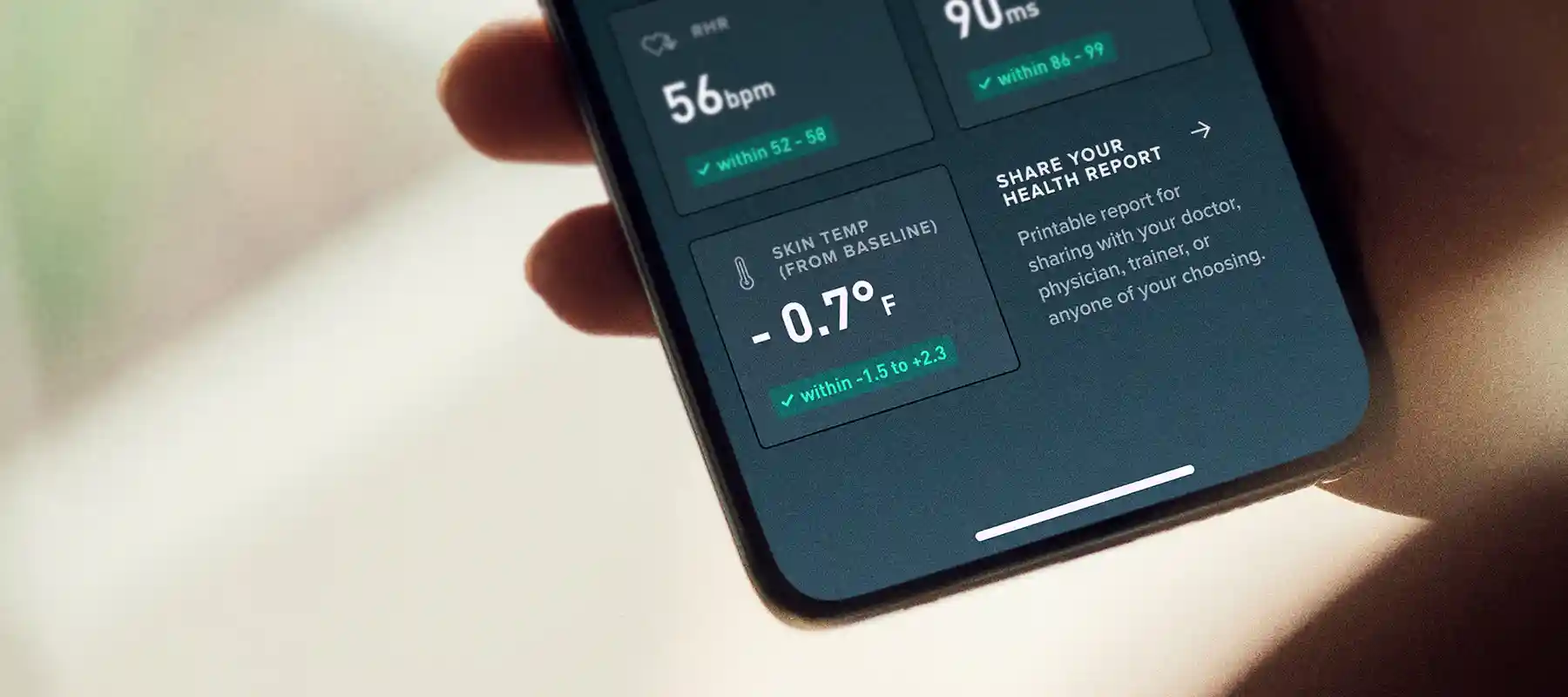
Sensors in the WHOOP device measure your nightly skin temperature for the Health Monitor. It can help you learn how well you're sleeping, identify trends and track your overall wellness.
While no external health monitor can track internal body temperature, the skin temperature sensor on the WHOOP device tracks your daily skin temperature to give you another layer of knowledge about how ready your body is to perform each day. Skin temperature is one of the metrics that WHOOP monitors daily to provide you with information about your overall wellness.
Skin temperature vs. core temperature
Your skin has a major role in regulating body heat, also called thermoregulation. During a vigorous workout, your body temperature rises and your sympathetic nervous system responds by causing your skin to sweat while dilating capillaries near the skin surface. This allows more blood to flow near the skin, where sweat evaporates and cools both the skin and the blood within the capillaries.
That cooled blood then returns to the core where it absorbs more heat, helping your body lose heat quickly. Conversely, when body temperature drops, the sympathetic nervous system pulls blood into the body's core and restricts blood flow near the skin to maintain warmth, causing you to shiver.
Skin temperature is typically a few degrees lower than core or body temperature, particularly on the wrist or arm where you may normally wear your WHOOP. Skin is exposed to the environment and subject to wind, weather, heating and air-conditioning, and may fluctuate throughout the day while your core temperature remains normal (98.6 degrees Fahrenheit or 37 Celsius).
What is a normal skin temperature?
While the average skin temperature for a healthy adult can range from 92.3 to 98.4 degrees Fahrenheit (33-37 Celsius), WHOOP focuses on what is normal for you. By establishing your personalized baseline from your sleep data, WHOOP helps you identify meaningful changes. Instead of focusing on a single number, you can monitor deviations from your typical range, which provides a more accurate look at your body's response to various factors.
What factors influence your skin temperature?
Your skin temperature can change in response to a variety of internal and external factors. These can include your sleep environment, like a room that is too hot or cold, or the number of blankets you use. It can also be affected by your body's internal state, such as fighting off an illness, recovering from a strenuous workout, or the natural fluctuations that occur during the menstrual cycle.
How WHOOP monitors skin temperature
The WHOOP device uses a sensor that sits directly above your skin to measure skin temperature. WHOOP builds a personalized baseline for your skin temperature using data from your previous sleep. Daily variations are shown in the Health Monitor where you can see how skin temperature correlates with other metrics such as live heart rate, blood oxygen levels, heart rate variability, resting heart rate, and respiratory rate.
WHOOP will notify you if your skin temperature deviates too far from your typical range. The WHOOP Journal allows you to log when you are feeling ill, which can help the algorithm correlate symptoms with changes in your skin temperature and other metrics.
Where to find skin temperature in the app
Skin temperature is one of the metrics in the Health Monitor.
When you open the WHOOP app you see an overview of the Health Monitor appearing on the homepage. Clicking on it will bring you to the Health Monitor, which displays your skin temperature.
What can skin temperature tell you?
Skin temperature can tell you about how strain and sleep are affecting your recovery. During the evening your core temperature decreases and gives off excess heat through the skin in order to cool for sleep. If your sleep environment is too hot, your skin temperature may reflect it, helping you adjust factors like blankets or fans for better sleep quality.
Skin temperature can also indicate microclimates such as a warm room, heat exposure or if you're fighting an illness.
Skin temperature and the Health Monitor
WHOOP monitors your skin temperature while you're sleeping.
Skin temperature is just one metric you can track with the WHOOP Health Monitor. You can see your live pulse rate, respiratory rate, heart rate variability, resting heart rate and blood oximetry in a single location in the WHOOP app. The Health Monitor will also let you know if any of these vitals are outside your normal baseline range.
Take control of your health
Understanding your skin temperature is another tool to help you decode your body's signals. By monitoring how it trends with your Sleep, Strain, and Recovery, you can make more informed decisions about your habits and environment.
Frequently asked questions about skin temperature
What should my skin temperature be on WHOOP?
WHOOP focuses on your personal baseline rather than a universal "normal" temperature. It calculates your typical range based on your sleep data. The key is to monitor deviations from this baseline, as they are more significant than the absolute number.
Why might my skin temperature be elevated on WHOOP?
An elevated skin temperature can be due to several factors, including a warm sleep environment, the onset of an illness, intense exercise late in the day, or natural hormonal changes related to the menstrual cycle. The WHOOP Journal can help you track these variables to identify patterns.
Can WHOOP measure basal body temperature for fertility tracking?
While skin temperature measured at the wrist is influenced by hormonal changes, it is not the same as basal body temperature (BBT), which is typically measured orally upon waking. However, many members find that tracking their skin temperature trends alongside the Menstrual Cycle Insights feature provides valuable information about their cycle phases.
With the exception of products specifically designated as medical grade, the products and services of WHOOP are not medical devices, are not intended to diagnose COVID-19, the flu or any other disease, and should not be used as a substitute for professional medical advice, diagnosis or treatment. All content available through the products and services of WHOOP is for general informational purposes only.