Topics
- Article
- Sensors
- Heart Rate
- HRV
WHOOP Accuracy: Industry-Leading HR & HRV Measurements

Wearable technology has the power to help people better understand their bodies and improve their health through personalized insights. However, recommendations across sleep, recovery, and training are only actionable if the underlying physiological data are accurate and reliable. Heart rate variability (HRV) and heart rate (HR) are two metrics for which accuracy and reliability are vital as they are at the heart of WHOOP scores. This article examines independent, third-party research validating WHOOP as the most accurate wearable for heart rate and heart rate variability measurements, explores the factors that influence sensor performance, and explains what this means for your health decisions.
Validation of six wearable devices
WHOOP is 99.7% accurate in measuring heart rate and 99% accurate in measuring heart rate variability, making it the most accurate wearable device according to independent research. The Australian Institute of Sport (AIS) funded an independent, third-party study conducted by Central Queensland University (CQUniversity), published in Sensors, that examined the accuracy of six wearable devices.
Key findings from the study:
- WHOOP accuracy: 99.7% heart rate, 99% HRV
- Other wearable's accuracy: 41-96% heart rate, 24-69% HRV
- Sleep tracking: WHOOP outperformed other devices in total sleep time
CQUniversity independently examined the validity of six wearables simultaneously on each participant against medical-grade ECG and polysomnography equipment. This head-to-head approach eliminates variables that typically make wearable comparisons unreliable.
Devices tested included:
- WHOOP 3.0
- Apple Watch S6
- Oura Ring Generation 2
- Garmin Forerunner 245 Music
- Polar Vantage V
- Somfit
How WHOOP measures heart rate with industry-leading accuracy
The CQUniversity study found that WHOOP was the most accurate of the wearables evaluated in measuring HR compared to gold-standard ECG-derived heart rate. WHOOP had the smallest errors in measurement with a standard deviation of 1 beat per minute (bpm) while other wearables ranged from 2.1 to 12.8 bpms.
A Bland-Altman plot visualizes the differences between two quantitative measurements. In the below analysis, the X-axis shows the gold-standard measured data and the Y-axis shows the difference between that standard and what each device reported.

Data clustering along the flat line at zero were perfect (the device calculated the same value as ECG) and errors are shown above and below that line. In comparison to other leading wearables, WHOOP clearly delivered the most accurate HR measurements.
Validating heart rate variability for a precise look at recovery
The CQUniversity study confirmed that WHOOP delivered the most accurate heart rate variability (HRV) measurements. WHOOP had the smallest error in HRV with a standard deviation of 3.9 milliseconds (ms) while other wearables ranged from 28.1 to 46.9 ms.
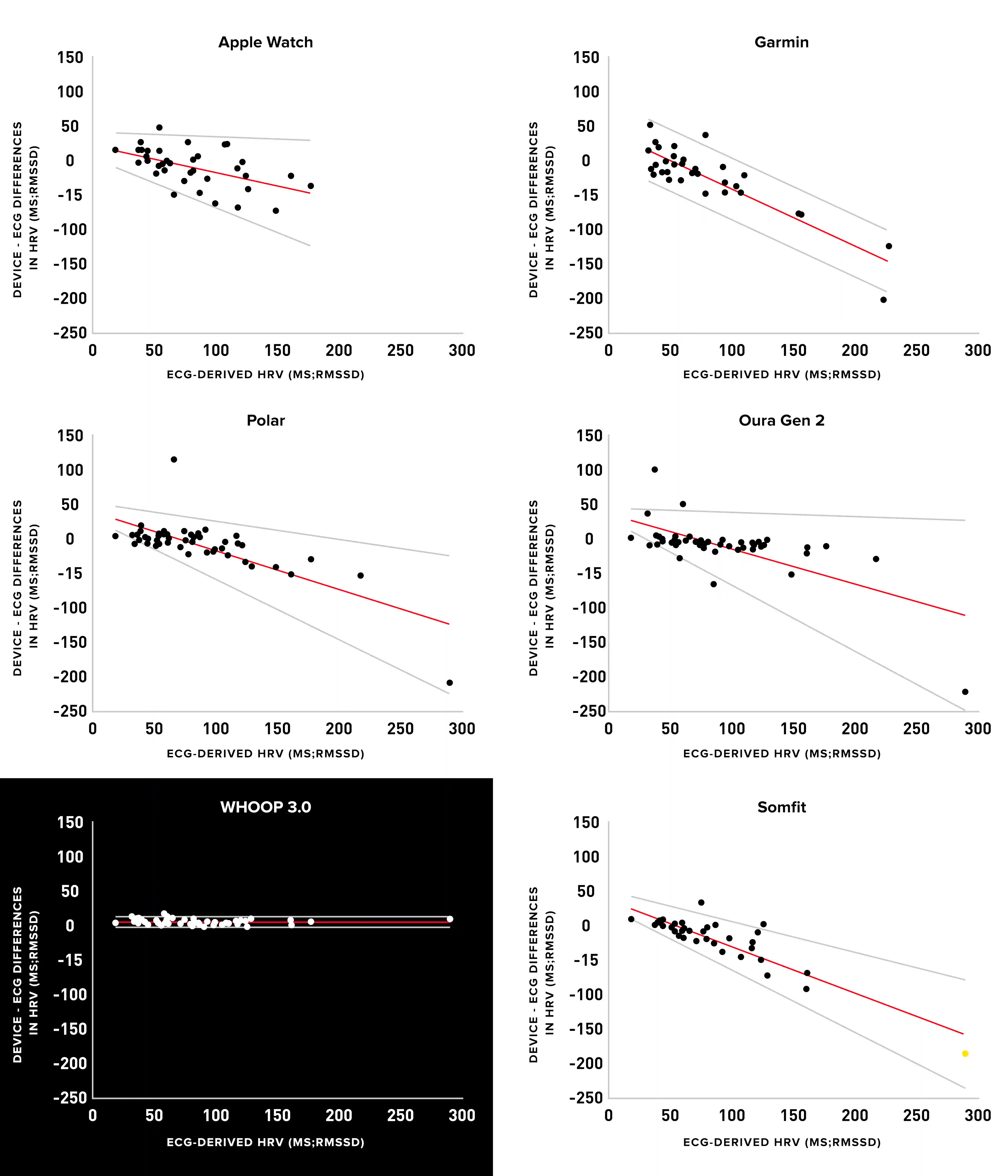
The analysis shows that WHOOP excelled in measuring HRV while other wearables were unreliable compared to gold-standard. Several other wearables struggled to measure higher HRVs — with some underestimating values by 200 ms. The highly accurate WHOOP readings ensure the data guiding your Recovery is a true reflection of your body's readiness to perform.
In a second independent study, AIS sought to determine the reliability of HR and HRV measurements by WHOOP to gauge readiness to perform in everyday use. Researchers monitored athletes wearing WHOOP over 16 weeks, comparing WHOOP automated readings to manual data collection. According to the study findings, "WHOOP allows for frequent and convenient measurement of HR and HRV" and can be "confidently utilised by sport and exercise science practitioners to record HR and HRV in practical settings."
Measuring sleep with gold-standard accuracy
Researchers tested sleep tracking capabilities compared to gold-standard PSG data. WHOOP and other devices calculate sleep via photoplethysmography (PPG), a technique that measures blood flow by assessing superficial changes in blood volume. Once blood flow is measured, we derive heart rate, heart rate variability, and respiratory rate, all of which are used in the WHOOP sleep detection and staging algorithm.
Among all wearables in the study with PPG sensors, WHOOP had the greatest agreement with gold-standard PSG for REM and slow wave sleep (SWS) measurements. WHOOP was found to be excellent in identifying sleep overall.

In reviewing the four stages of sleep, REM sleep is when your brain is restored and SWS sleep is when your muscles repair and grow. Those two stages make up restorative sleep which is essential for recovery. This precision allows WHOOP to provide actionable, personalized insights to help you improve your sleep quality and overall health.
How accurate data powers your WHOOP insights
Accurate measurement of HR and HRV is the first step. The real power comes from translating that data into personalized insights. Your daily Strain and Recovery scores are calculated using your precise HRV and heart rate data, while Sleep Performance is determined by how accurately WHOOP measures your sleep cycles.
How to get the most accurate data from your WHOOP
To ensure you get the highest quality data, proper wear is key. Your WHOOP should be worn snugly on your non-dominant wrist, about one inch above your wrist bone. During intense activity involving significant wrist flexion, moving the device further up your arm can improve consistency.
Keeping the sensor clean and dry helps maintain a strong signal for precise measurements.
What this means for WHOOP today: the commitment to continuous improvement
The validation provided by both studies from the Australian Institute of Sport underscore the quality of WHOOP measurements that underpin the personalized recommendations we provide to our members. Since these studies were published, WHOOP has continued to build on this foundation — evolving both hardware and software to push accuracy further. WHOOP 5.0 and WHOOP MG feature an upgraded sensor array and refined signal processing, and the heart rate algorithm has undergone comprehensive rework, improving accuracy across daily wear, exercise, and everything in between.
WHOOP treats heart rate accuracy as a continuous investment. Our Signal Processing and Data Science teams are always refining algorithms informed by WHOOP Labs research, real-world member data, and an expanding dataset that spans millions of hours of wear. Additional accuracy improvements are already in development, with updates delivered automatically through firmware — no new device required. The result is a WHOOP experience that keeps getting better over time, built on the same commitment to accuracy that these independent studies validated.
WHOOP Labs is always conducting research and looking for different people to participate in studies. Visit whoop.com/whoop-labs to learn more about how to take part in current data collections in Boston.
Frequently asked questions about WHOOP accuracy
How does WHOOP accuracy compare to other wearables?
An independent study conducted by Central Queensland University found WHOOP to be the most accurate wearable for measuring heart rate and heart rate variability when compared to several other popular devices. The study used gold-standard ECG and PSG measurements as the benchmark for comparison.
What can I do if my data seems inaccurate?
If you have concerns about your data, first ensure your device is worn correctly — snug and properly placed on your wrist. You can also try cleaning the sensor. For activities with a lot of wrist motion, consider using WHOOP Body apparel or moving the device higher up your arm.
*When compared to the gold-standard electrocardiogram-derived (ECG) metrics