Topics
- Article
- Cycling
- Recovery
- Sleep
Death Valley Bike Ride — 700 Miles Across Harsh Terrain
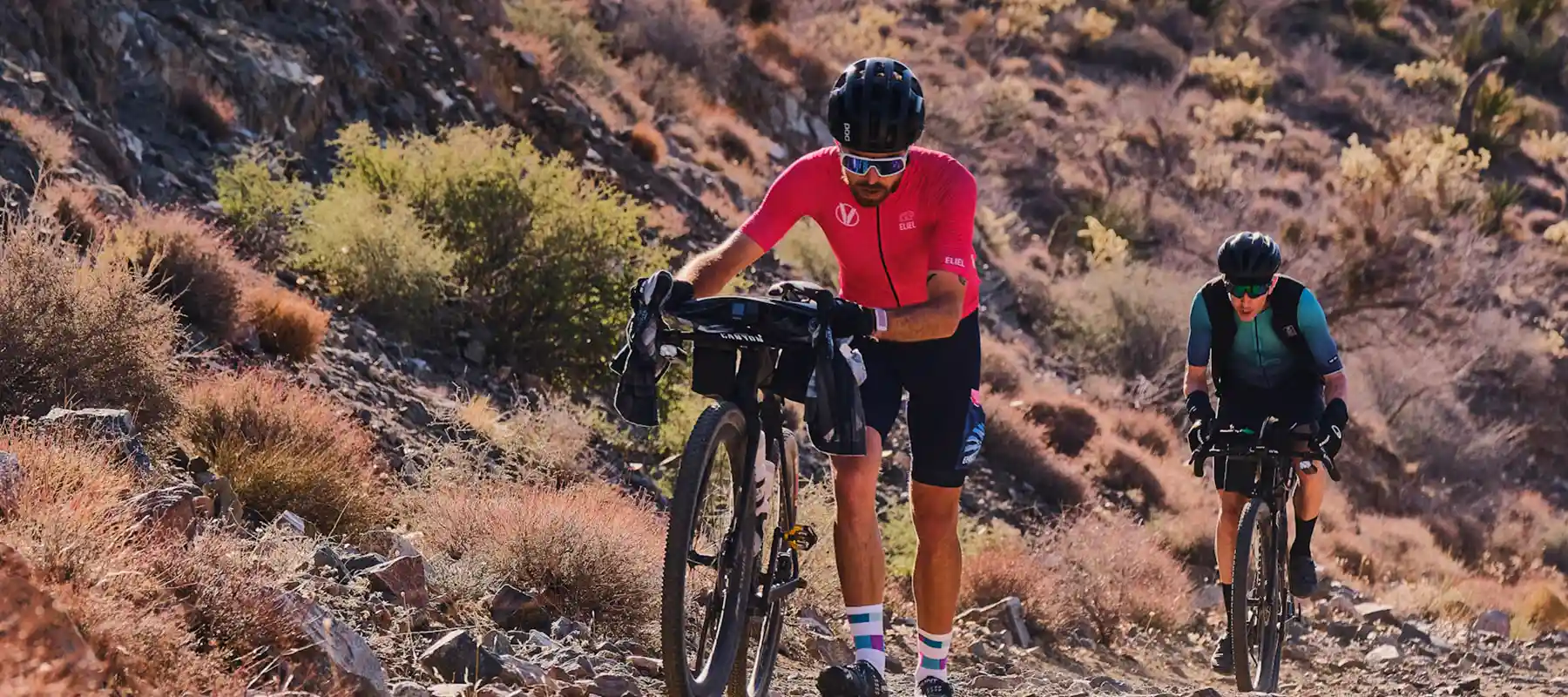
Death Valley cycling represents one of the most extreme endurance challenges on the planet. The combination of scorching heat, remote terrain, and relentless elevation changes tests the limits of human performance. This guide covers everything you need to know about cycling in Death Valley—from planning your trip and choosing the right route to understanding how your body responds to days of sustained effort in one of Earth's harshest environments.
Cycling the impossible route
The "impossible route" mantra is about overcoming what you once thought was impossible. For some it's a volcano, for others it's their first century (100-mile ride), and for some it's simply riding that first mile. We set out to push ourselves to the breaking point and beyond with a goal of inspiring others to conquer their own personal "impossible route."
I attempted this impossible route with my friend and professional mountain bike racer Jeremiah Bishop. It was a 7-day, 700-mile adventure through the heart of the Mojave Desert and Death Valley on rigid suspension gravel bikes (basically road bikes with bigger tires). We rode a well-known motorcycle course called the California Backcountry Discovery Route (CABDR), but nobody had ever attempted it on a bicycle before.
Tyler Pearce and Jeremiah Bishop on Day 1 of their "impossible route" through Death Valley.
Jeremiah and I decided that we needed to finish each stage under our own support (customary in mountain bike stage racing), which meant carrying with us enough water and food to get from the start to the finish each day. Below I'll dive into my WHOOP data and show how my body was affected by dehydration, lack of sleep, and massive efforts on the bike for 7 straight days. You can check out the full film on my YouTube channel.
Planning your Death Valley cycling trip
Cycling in Death Valley demands respect for the environment and meticulous planning. The best time to ride is during the cooler months, from late fall to early spring (October to March), when daytime temperatures are more manageable. Summer is dangerously hot and should be avoided.
Your primary concerns are hydration, nutrition, and sun protection. There are very few water sources in the park, so you must carry more water than you think you will need. A support vehicle is highly recommended for multi-day trips to carry supplies.
Cellular service is virtually nonexistent, so plan your route in advance and have offline maps and a satellite communication device. Always inform someone of your route and expected return time.
Popular Death Valley cycling routes
While the 700-mile journey is an epic feat, Death Valley offers several routes for cyclists of varying levels. These rides provide a taste of the park's unique landscape without the multi-day commitment.
- Artist's Drive: A 9-mile, one-way paved loop with rolling hills and spectacular views of the colorful mineral deposits on the Black Mountains. It's a great option for a shorter, scenic ride.
- Badwater Road: This relatively flat road runs along the valley floor, offering an out-and-back ride from Furnace Creek to Badwater Basin, the lowest point in North America. You can customize the distance, but the full round trip is about 34 miles.
- Dante's View: For those seeking a significant climbing challenge, the ride up to Dante's View offers a strenuous ascent with a rewarding panoramic view of the entire valley from over 5,000 feet.
Day 1: Managing immense Strain from the start
I came into the adventure a little under fit and heavy compared to my normal race fitness and weight. The thought was to prepare my body for major caloric deficits every day and leave room for fatigue to build up. If I'd come in super lean and race fit, the first couple of days could have been fine, but by Day 5 or 6 I'm certain I would've cracked.
With a ton of pre-adventure nerves, I got less than 6 hours of sleep the night before we began. The travel day to get to the start also played a major role in kicking this off in the red (a 29% WHOOP Recovery on Day 1). We had driven 14 hours to Yuma, AZ, and with the added stress of getting everything ready for the biggest week on the bike I'd ever done, I was wrecked.
It took us 10 hours of ride time to cover 117 miles of deep sand and steep climbs that day. I burned almost 7,000 calories, and there was no way I could bring that back in during the ride.
Tyler's heart rate spanning his 10+ hours on the bike on Day 1, including max hR and calories burned.
I ended the day with a 20.7 WHOOP Strain (measured on a 0-21 scale) and felt like death. Luckily, Biju Thomas, the world's best cycling chef, staged meals for us to help get back in the salts, fats, and calories we burned.
Day 2: The impact of extreme effort on resting heart rate
Waking up on Day 2 with a Recovery score of 5% was a bit of a worrisome sign. I did actually get more sleep than I thought I would, but with so much Strain the day before it was clearly not enough to properly recover. My resting heart rate (RHR) also jumped from 52 to 64 beats per minute!
There was a significant spike in Tyler's resting heart rate following a very strenuous first day of riding.
I struggled to get moving, basically just putting one foot in front of the other. It was another 10 hours on the bike which saw us cover 132 miles, most of which included deep sand washes that made riding super difficult. The day ended with an hour-long climb and we both ran out of food and water.
We barely made it to the finish, and immediately rushed to hydrate and get food back in us so we could get to sleep as fast as possible. I needed some quality sleep to hopefully get my Recovery back on track if I was going to have a chance to complete the next day.
Day 3: How a lighter day helps your data trend up
I managed 7 hours of sleep, which was pretty good considering how late we got in the day before and how early we had to wake up. While my Recovery was still in the red, at least it was moving in the right direction (up to 24%). My RHR was still extremely high though (63 bpm), but I hoped Day 3 would be an easy one.
An "easy" Day 3 led to Tyler's WHOOP data Heading in the right direction.
Luckily my wishes were answered, and we had a blazing tailwind over a much easier course. I still felt like a sack of potatoes, but with "only" 5 hours on the bike and 70 miles to ride we ended with plenty of time to fuel, shower, and recover before the biggest and most challenging day of the trip.
Day 4: The role of restorative sleep before a peak challenge
Seeing my body bounce back into the green (74% Recovery) prior to the hardest day of the adventure was huge for my morale. Although my total sleep wasn't much better than previous nights, my time in REM (2:02) was significantly higher.
Tyler got an excellent amount of restorative REM sleep prior to Day 4.
Day 4 was 125 miles that covered the most hostile terrain I've ever ridden. We went through the heart of Death Valley and right by the Ibex Dunes. I actually felt really good the whole day, which was key to even having a shot at finishing.
Day 5: Why recovery can rise even during multi-day strain
Sleep was still hard to come by—we got in late the day before and woke up early. But I continued trending upwards in my WHOOP metrics. My Recovery was 82%, and my heart rate variability (HRV) and respiratory rate were looking good.
Day 5 was spectacular. We had lots of road (a much welcomed "break" of smoother riding), we got to ride through scenic Titus Canyon, and both Jeremiah and myself were feeling great! However, the course was long (101 miles) and we had no ability to refuel, so we ended up needing to pull the plug early when we ran out of light, calories, and water.
On Day 5, Tyler's recovery was in the green and he was feeling good.
Day 6: Peaking heart rate variability deep into the ride
Howling winds overnight made for some difficult rest, but I was able to sleep in a bit and catch up what I could. Being 6 days in and seeing my highest HRV (122 ms after having dipped as low as 29 ms on Day 2) of the trip was crazy. I knew there was an extremely tough ride coming, so having that 91% Recovery in my pocket was a life saver.
We put in another 10-hour day on the bike (and 72 miles), with several moments where quitting felt like the only option. Somehow we pushed through and made it to the finish. With only one day left to go there was no stopping now!
Day 6 featured 10 hours of cycling across some brutal terrain, leading to a 20.6 day strain for Tyler.
Day 7: How the body adapts to finish in the green
With my largest amount of total sleep yet (7:29), I woke up on the last day to another green Recovery. My RHR was back down to normal (44 bpm) and my body had seemingly adapted to this level of Strain (a string of 20.6s and 20.7s) every day. I actually felt better on the final day of this journey than I had in weeks!
Despite near-max strain For 7 straight days of cycling, Tyler had an impressive string of green recoveries to close out the epic ride.
Amazingly we smashed the last stage, flying through the 8-hour ride and 91 miles with no issues. Jeremiah and I became the first people to complete the CABDR on bicycles.
The final day was mostly smooth sailing... Until Tyler crossed the finish line.
We did it! I was feeling a sense of euphoria like never before—then I crashed in the parking lot of the finish line. I had ridden 701 miles over the hardest terrain in America only to break my femur in a Taco Bell parking lot.
My Recovery the next day was 27%, and it was almost two weeks before I got it back in the green. Images via JPOVPhoto
Train smarter for your own impossible route
Tyler's journey through Death Valley demonstrates the incredible resilience of the human body, but it also highlights the critical importance of listening to its signals. By monitoring his Strain, Sleep, and Recovery, he was able to understand how his body was adapting to unprecedented stress and make adjustments that were key to his success. Whether your impossible route is 700 miles or your first 10, understanding your physiological data is the key to pushing your limits safely and effectively.
Frequently asked questions
When is the best time to cycle in Death Valley?
The safest and most pleasant time to cycle in Death Valley is from late October to March. During these months, daytime temperatures are typically mild to warm, ranging from the 60s to 80s Fahrenheit. The summer months (June through August) should be avoided, as temperatures regularly exceed 110°F (43°C), creating extremely dangerous conditions for any strenuous activity.
What is the 80/20 rule and how can it help my training?
The 80/20 rule is a training principle where about 80% of your weekly training time is spent at a low intensity (Zone 2 heart rate), and the remaining 20% is dedicated to moderate and high-intensity efforts. This approach builds a strong aerobic base, which is crucial for endurance events like long-distance cycling. It helps improve your efficiency and stamina while minimizing the risk of overtraining and burnout, allowing you to be fully prepared for your goal.
What are the most important metrics to monitor for an endurance ride?
For a multi-day endurance ride, focusing on a few key metrics can guide your performance and recovery. Pay close attention to your daily Recovery score to gauge your readiness to take on Strain. Monitor your resting heart rate (RHR) and heart rate variability (HRV)—a stable or rising HRV and a low RHR are good indicators of recovery—and track your Sleep Performance, as sleep is the most powerful tool your body has to repair itself and prepare for the next day's effort.