Topics
- Article
- Circadian Health
- Sleep
Circadian Rhythm: How It Works

Your body operates on a 24-hour internal clock that governs when you feel awake, when you feel tired, and how well you recover. Understanding this rhythm — and learning how to work with it — can transform your sleep quality, daily energy, and long-term health. Below, we explain what circadian rhythm is, how it works, what can disrupt it, and how maintaining it with sleep consistency leads to measurable improvements in performance and recovery.
What is circadian rhythm?
The word "circadian" is based on the Latin terms for "around" (circa) and "day" (diem), so your "around-the-day" rhythm dictates the cycles your body goes through—most notably when you wake up and fall asleep. Your circadian clock is controlled by a part of your brain called the hypothalamus that responds to light. As it gets dark, your brain tells your body to begin producing melatonin, which makes you feel tired.
How your circadian rhythm works
Your circadian rhythm is governed by a master clock in your brain called the suprachiasmatic nucleus (SCN), located in the hypothalamus. This internal clock responds primarily to light, the most powerful signal for syncing your body with the 24-hour day.
When your eyes detect light in the morning, the SCN signals your body to produce hormones like cortisol to promote wakefulness and energy. As darkness falls, it triggers melatonin release, the hormone that helps you feel tired and ready for sleep.
While everyone operates on this 24-hour cycle, your personal timing — or chronotype — can vary. Some people are natural "early birds" who feel most alert in the morning, while "night owls" peak in the evening. Understanding this internal timing is the first step toward working with your body, not against it.
What disrupts your circadian rhythm
Shift work with frequently changing hours, jet lag from switching time zones, certain medical conditions, or even simply choosing to stay up late one night are all things that can throw off your sleep patterns and circadian rhythm. In the long run, studies show this can negatively impact your health in a variety of ways.
Many of us often look to catch up on lost sleep on the weekends, but averaging 8 hours of sleep per night is not the same thing as getting 8 hours every night. "Sleeping in" one or two days a week can actually disrupt your biological clock by creating an irregular sleep-wake rhythm.
How circadian rhythm affects your health and performance
A 2017 Harvard study discovered that students with consistent sleep and wake times had higher GPAs than others, despite not actually getting more sleep. Inspired by this, WHOOP introduced Sleep Consistency tracking in 2019, and the results are staggering.
Our data shows that better Sleep Consistency contributes to:
- More REM sleep, the mentally restorative stage of sleep
- Increased slow wave (deep) sleep, the physically restorative stage
- Lower resting heart rate
- Higher heart rate variability (HRV)
- Improved mental health
We've also learned that greater Sleep Consistency helps you fall asleep faster and improves your overall sleep efficiency (the percentage of time in bed that you're actually asleep).
WHOOP data shows that keeping your circadian rhythm aligned with Sleep Consistency also improves the efficiency of your sleep.
How to improve your circadian rhythm with Sleep Consistency
Aligning your daily behaviors with your internal clock is key to better performance and recovery. The single most effective way to support your circadian rhythm is to maintain a consistent sleep schedule— going to bed and waking up around the same time each day, including weekends. This practice, which WHOOP measures as Sleep Consistency, helps your body anticipate when to wind down and when to power up.
You can further reinforce this rhythm by managing your light exposure. Aim for natural sunlight in the morning to signal wakefulness, and reduce exposure to bright screens and artificial light in the evening to allow for natural melatonin production.
Sticking to consistent bed and wake times, tracked in the WHOOP app, helps maintain your circadian rhythm.
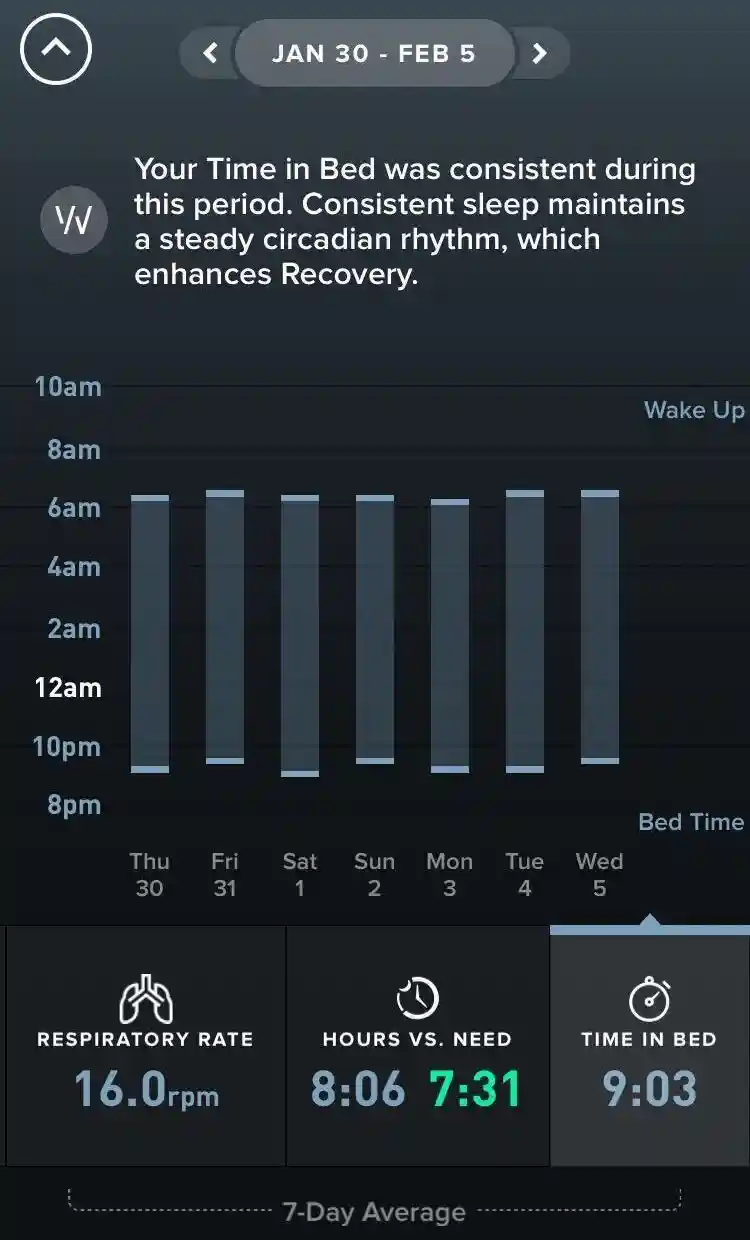
Monitor your circadian rhythm with the WHOOP Sleep Planner
WHOOP is 3rd-party validated to accurately track your sleep in great detail, including a breakdown of the amount of time you spend in each stage of sleep. The Sleep Planner makes nightly recommendations for exactly how much sleep you need. It also tells you precisely when to go to bed and wake up in order to maximize your Sleep Consistency and get the highest quality sleep possible.

Frequently asked questions about circadian rhythm
How do you know if your circadian rhythm is off?
Common signs of a misaligned circadian rhythm include difficulty falling or staying asleep, persistent daytime fatigue, mood swings, and trouble concentrating. WHOOP can help you see the effects of misalignment in your data, often reflected in lower Sleep Performance, inconsistent sleep staging, and reduced daily Recovery scores.
What is the healthiest circadian rhythm?
The healthiest circadian rhythm is not a specific schedule, but a consistent one. It is a stable 24-hour cycle that allows you to get the sleep you need to feel and perform your best. The ideal rhythm is one that aligns with your chronotype and lifestyle demands, enabling you to go to bed and wake up at roughly the same times every day.
What is the difference between circadian rhythm and sleep cycles?
Your circadian rhythm is your body's 24-hour internal clock that regulates your overall sleep-wake patterns. Sleep cycles are the repeated 90-minute phases of different sleep stages — light, deep, and REM sleep — that occur throughout the night while you are asleep. In short, your circadian rhythm tells you when to sleep, and sleep cycles describe what happens while you are sleeping.